
Take a gander at our FTC disclosure opus here ...
Motorcycle Tech Screens Bring It All Together
In-ride action cams, especially during the advent of the GoPro era, fast became a great way to show friends, family and fellow riders the goods in terms of what we do, where and why. Following in kind, Bluetooth tire pressure monitor systems would make riding that much safer with alerts about questionable rubber before catastrophe strikes. In the event of a plugged flat needing to be replaced, a dedicated GPS unit might then offer up a quick-route to the nearest tire source.
“A motorcycle tech screen helps simplify the ever expanding collection of handlebar mounts while reducing LCD distractions.”
The importance of these products isn't often known until proof of concept lands and a few influential cohorts murmur about it under their breath. Once the word is out, though ... once we all begin feeling the positive effects, hindsight gets harder to observe. Action cams document a great day (or questionable learning moment), TPMS offers peace of mind while silent and the GPS keeps everything on track.
Every one of these components continues to improve as time goes on. The cams' audio/visual fidelity becomes clearer, Bluetooth versions and sample rates ramp up and global triangulation meets millimeters. The improvements, exponential, happen at blinding speed, up to now covering only a single decade.
Regardless of the occasional anti-rider duct taping tech over their helmet visor viewport, the positive impact of these technologies on both safety and convenience far outweighs the negative. Yes, we all have a friend or three who feel ABS means they don't need to know how to use their brakes anymore but the majority of sport touring riders are too geeked about next-level skill to let prior understanding slip away. The same can (and should) be said for the augmented reality new tech can provide, especially when it raises the safety bar and lowers rider stress.
Purchasing each of these enhancements independently, however, used to clamp so many awkward buttons and screens across our handlebars that fellow commuters might mistake us for a ten-point buck. I'm writing to suggest those days can be gone if we hybridize the lot to a single motorcycle tech screen, one that's simple, glove-friendly and able to juggle all we ask of it. What's more, there are several options to choose from, the current leading manufacturers being Chigee, Aoocci and Carpuride.
Meet The Contenders
Again, it's all about current, weatherproof and glove-friendly Android Auto/CarPlay displays. Each combines navigation, TPMS and front/rear recording with a proven active-clip save function. All were "conjured" from independent evidence, manufacturer support and complete-system value across a varying price range.
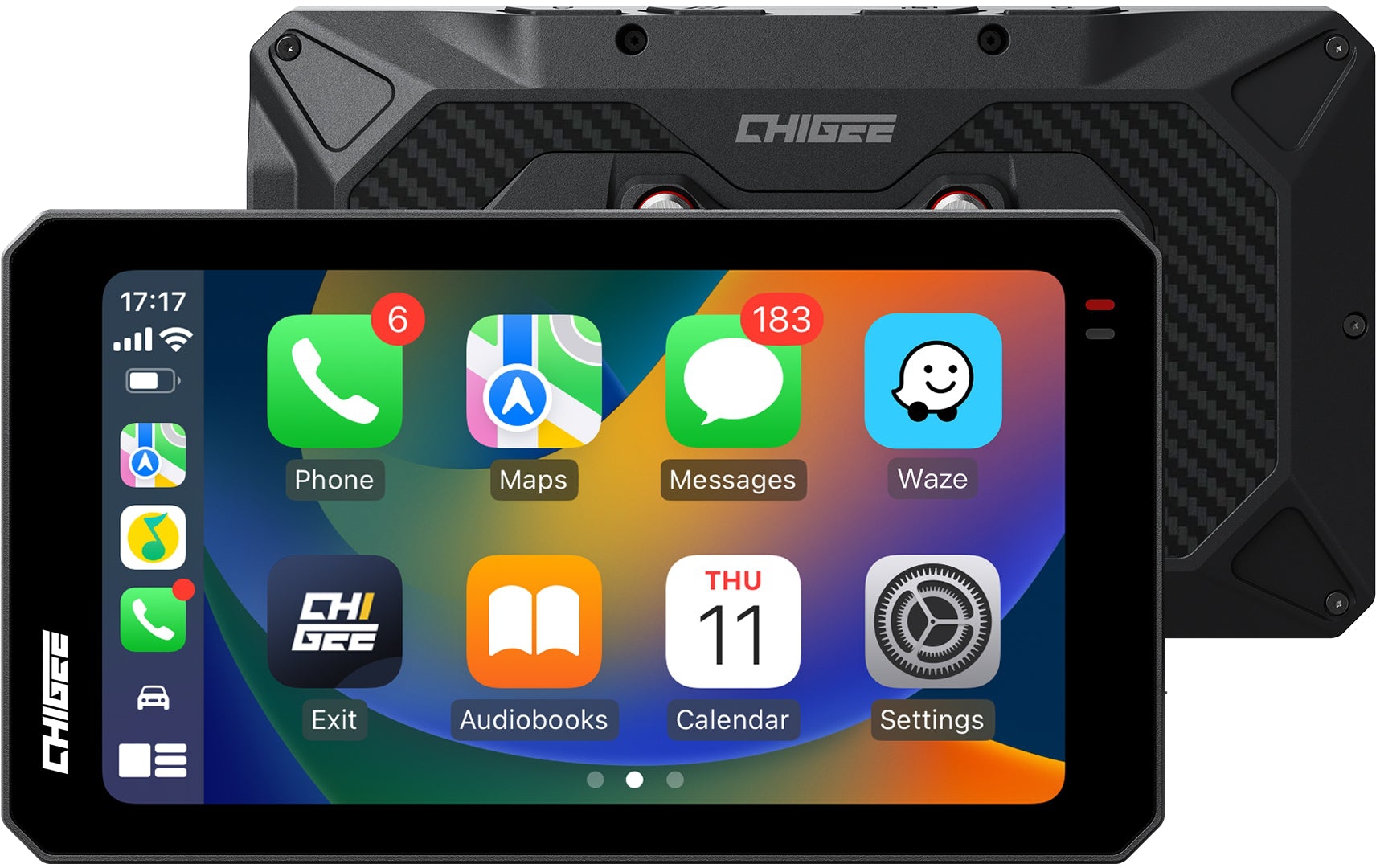
Chigee AIO-6 Max: Best Overall
The Chigee AIO-6 Max gets first chair for its bright 6" screen, four physical buttons and refreshingly sorted interface. BikeSocial's months-long test praised the build, mounting choices and general usability while Chigee's support guide proves the current recording can be locked manually. At bookoo dollars for whatever display/cameras/TPMS combination, it costs substantially more than its competition.
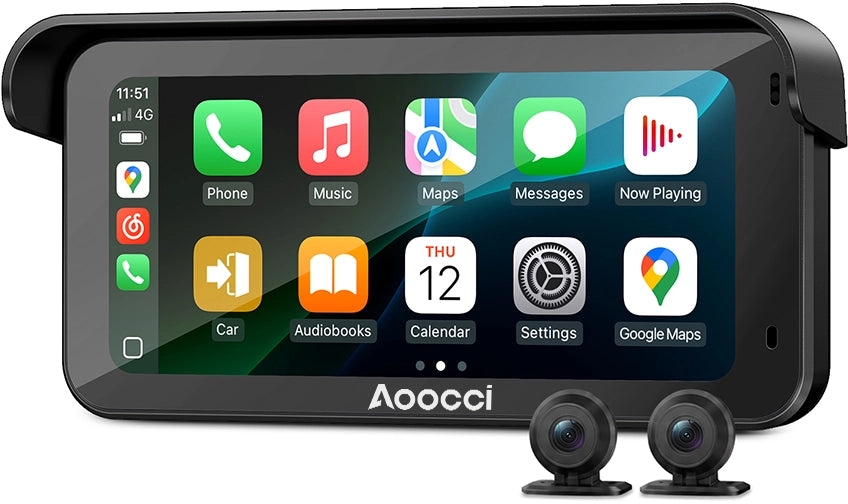
Aoocci C6 Pro: Best Complete Value
The Aoocci C6 Pro packages a 6.25" thousand-nit screen, wireless Android Auto/CarPlay and two 1080p 140° cameras. Its current documentation adds pressure/temperature TPMS, an included wired controller and a manual emergency-clip lock on top of the automatic G-sensor protection. The exact available kit includes the cameras, TPMS, controller and 64GB card, making it the least expensive answer.
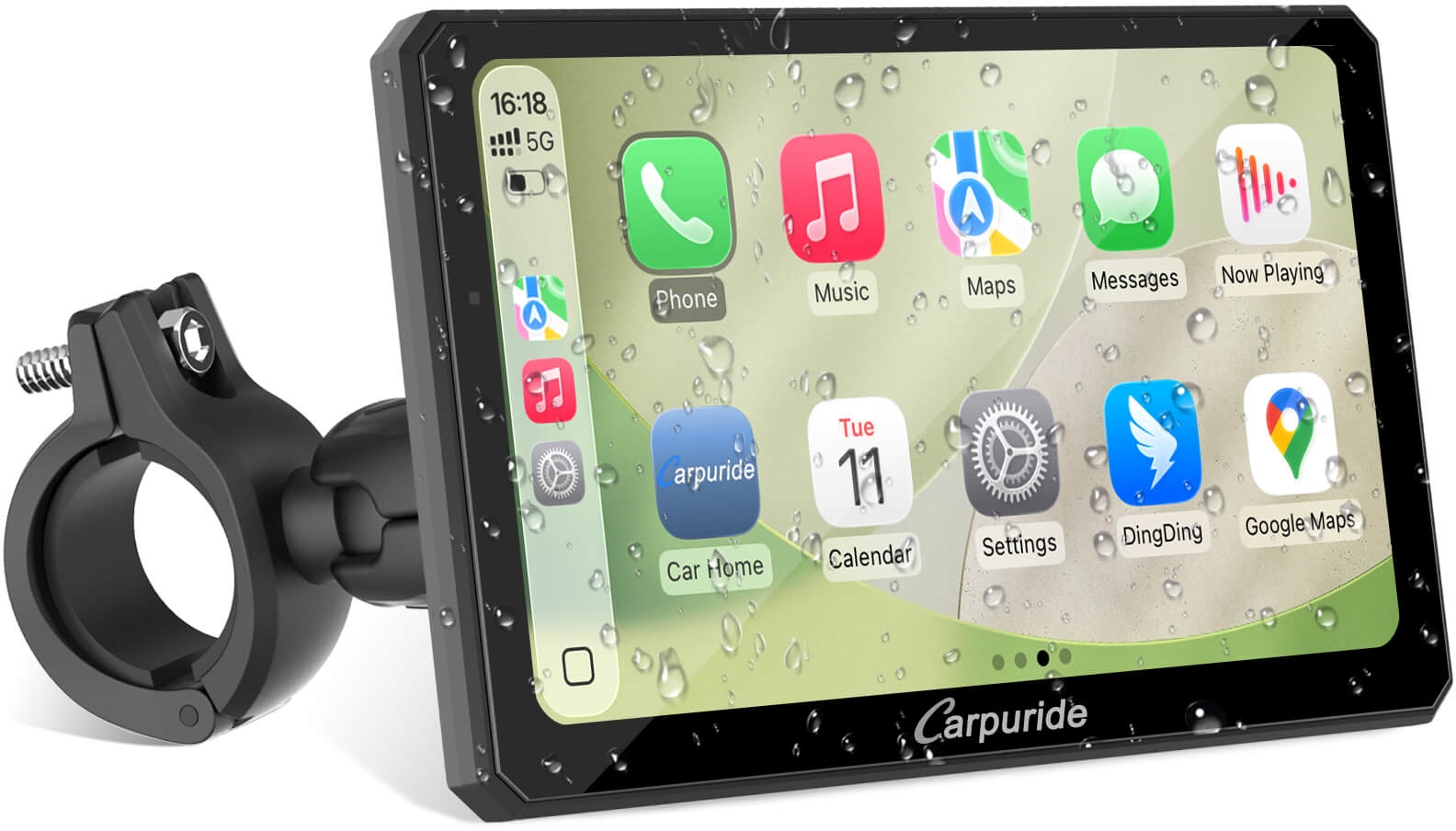
Carpuride W712DT: Best Big-Screen Alternative
The Carpuride W712DT brings a rotatable 7" screen, wireless Android Auto/CarPlay and dual 1080p cameras to the same consolidated job. A disclosed hands-on test showed its controller moving the active recording into an SOS folder while rain, hail and mud gave the IP67 claim something less polite than a brochure to answer. Also included are TPMS, a 64GB card and the wired controller.
Only one motorcycle tech screen candidate survived both a top-shelf road test and the retro-save proof hunt: Chigee's AIO-6 Max. Aoocci and Carpuride fill the empty chairs with current kits whose makers document a physical current-clip lock. The INNOVV N2 stayed out because neither its manual nor testing proved a manual lock for footage already rolling.
Motorcycle Tech Screen (Required) Key Features
I'll admit right here, right now that I know my demands will become more and more smirk-worthy for their obsolete rotary phone-ned-ness as days pass but as of this publishing date, my inspiration is my want for the above three functions (video, TPMS, GPS), contained in a single unit that's weatherproof and glove-friendly with full support for Android Auto. My exploration into the prospects added Apple CarPlay to the software list. If I find one that works with that 2017 Windows Phone, just ... never mind.
DVR Capabilities
Ride footage oughta include whatever "hyper ultra x-ray time travel" resolution is trending, currently 1080p, with hope for a 140° viewing angle. That means memory card support so we can revisit those wicked switchbacks after the fact! Night vision capability is a nice touch to boot but the real demand I insist on has a story stuck to it ...
A friend who resides in NYC was warned that local police were stopping motorcyclists along their commute, handing them tickets for inventive reasons, conjured from non-reality. This friend had installed a motorcycle tech screen with a two-cam system. When an officer handed them a pre-written ticket, explaining that the rider had coasted through a red light, they pressed a simple "save" button which stored the most recent fifteen minutes of riding to memory (local and cloud).

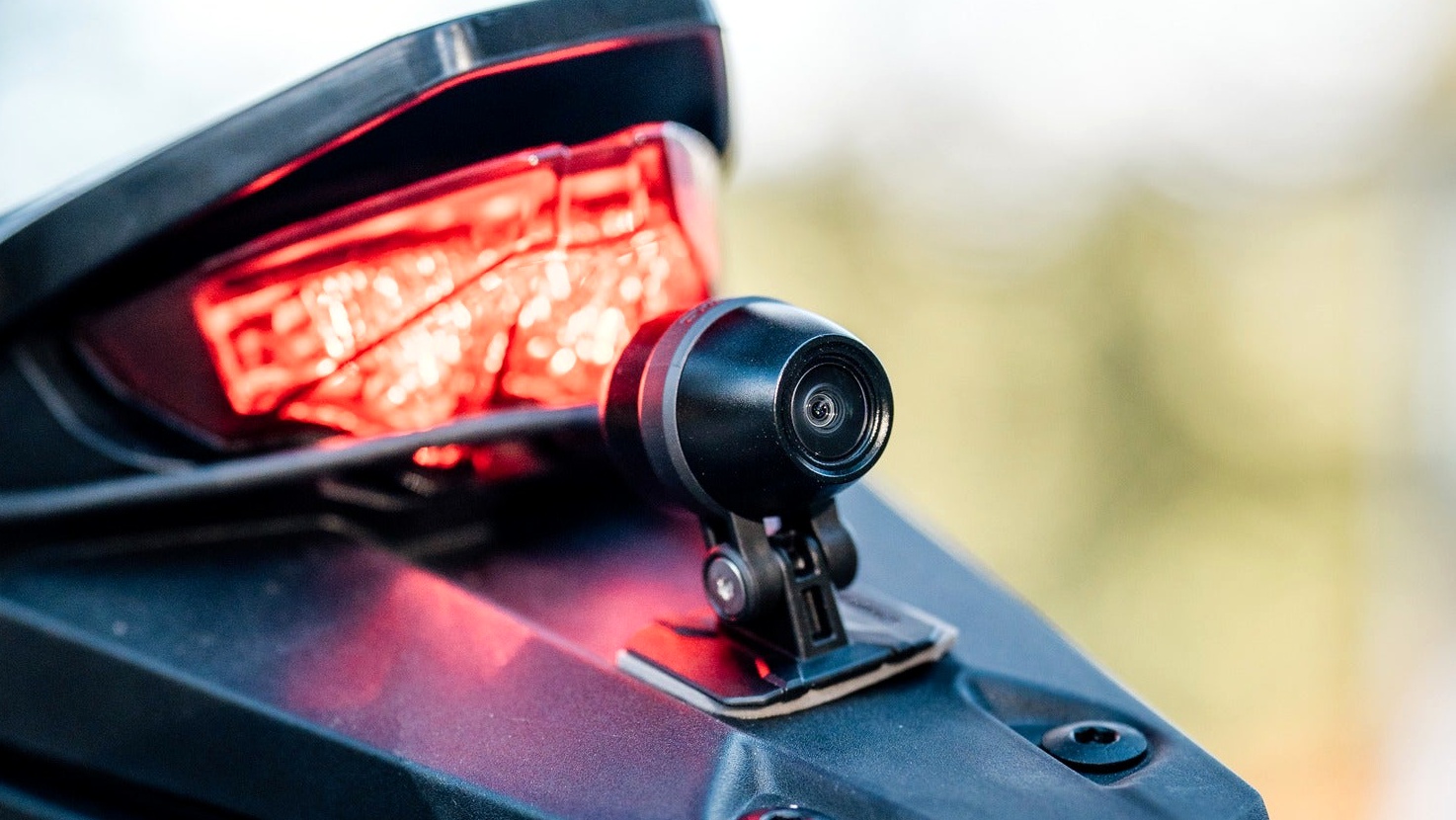
The rider then carefully and politely said, "No, officer, I did not," while gesturing toward the front camera with certain but neutral confidence before being promptly excused without the extra paperwork.
While they told me this story, I couldn't help but think about how often I'd want to document a great motorcycle route or event. I'd have to pull over, boot up my "hopefully still charged" GoPro and start recording. Having two directly-powered cameras loop recording (plus a G-sensor for accident detection) would allow me to ride under less pressure, only tapping the "save" button when my grin deems it worthy.
Moreover, two cameras beat one! Every "legend in their own mind" rider, my humble self included, wants independent front and rear recording angles. Show that track day bottleneck just ahead becoming a shrinking figure behind, the two camera files telling both halves of the story!
DVR/Cam Features Compared
Chigee AIO-6 Max - accepts an optional pair of Sony Starvis cameras that record front and rear at 1080p/60fps. Chigee documents selectable one, two or three-minute loop files plus a screen or controller command that locks the current recording against overwrite. That saves whatever has already accumulated inside the active segment, not the fixed fifteen-minute rewind from our opening story.
Aoocci C6 Pro - uses front/rear 1080p cameras with a claimed 140° view, HDR assistance and 30fps capture. Its official page lists one, three or five-minute loop files and says the wired remote can lock an emergency clip while gloved. The same active file also locks automatically after a G-sensor event, giving us both deliberate and collision-triggered protection.
Carpuride W712DT - records front and rear at 1080p/30fps with a claimed 140° view and split-screen monitoring. During a hands-on test, a controller long-press produced a "locked video" announcement and moved the active file into the protected SOS folder. The test showed one-minute files by default with an option for five, so the button preserves the already-recorded part of that current segment.
Tire Pressure Monitors (TPMS)
We've explored a good many aftermarket, modular, outboard TPMS variations in depth with a certain dedication to the Fobo brand. Dated as that Fobo article may seem, I still have a pair installed on my newest ride and it's alerted me to a puncture-induced deflation three times in the past year. Fobo's system also monitors tire/air temperature, which is a nice touch.
If I order a motorcycle tech screen from our contender list, it'll include its own pair of tire pressure sensors. That doesn't necessarily mean I have to use them, though as the screen will employ Android Auto or Apple CarPlay, a clone of whatever smartphone/Bluetooth interfacing we're used to. That also goes for any already-installed Android/iPhone related motorcycle tech we've adapted.
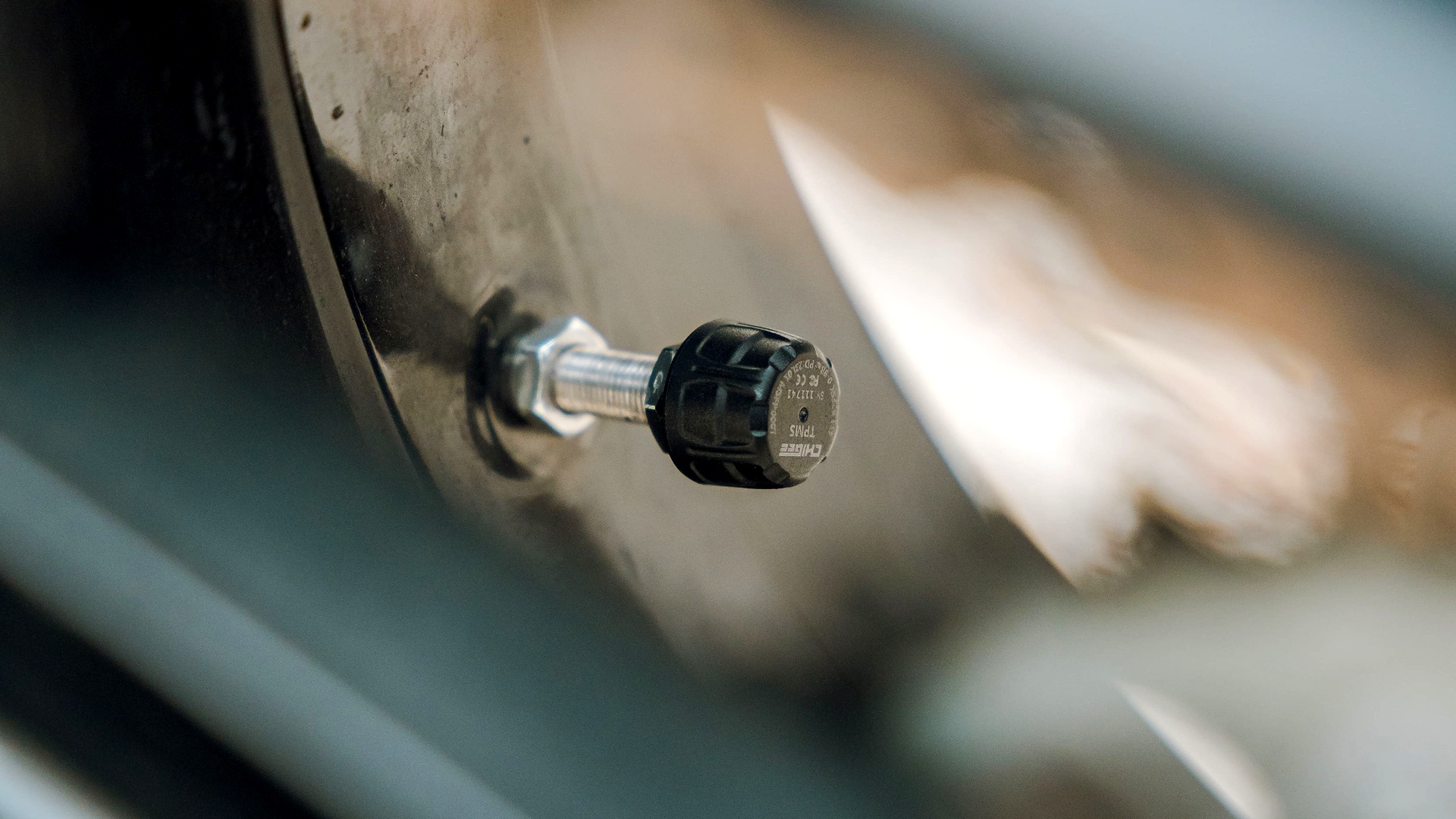

Whether I prefer the perhaps smaller, more manageable included sensors or the system forces my hand by requiring them, I'll use the Fobos on a different machine or stash 'em as backups.
Either way, we're gonna want two or three (lookin' at you, trikers) compatible sensors, operating in real-time, paired with an alert system for abnormal tire pressure and/or temperature while we focus on the fun part: riding! Bonus points for ease of installation and calibration, less any "uncork the farfishnargan fifteen times while pre-double-side-pressing the conkenshnoogle". It's a motorcycle, not a Photoplayer.
TPMS Features Compared
Chigee AIO-6 Max - supports external valve-cap sensors with replaceable batteries or internal sensors with a claimed two-to-three-year lifespan. Either pair puts pressure and temperature on the main dashboard without borrowing a phone app. Tests caught one stale reading after a sensor was removed, which means the display assists rather than replaces a proper gauge.
Aoocci C6 Pro - includes front/rear sensors and reports pressure plus temperature in real time. High and low pressure thresholds are adjustable for each tire with visual warnings delivered on the display. That's the cleanest out-of-box TPMS arrangement among these three.
Carpuride W712DT - comes with two sensors and supports wheel-specific pairing through the display. Custom pressure alarms can be set after the correct vehicle mode and sensor codes are entered. Setup asks for more button work than Aoocci but the adjustable warnings land in the same useful place.
GPS Navigation Features
Here's where opinions that could get heated likely won't. Every rider has their preferred navigation platform or lack thereof. While this bit is a moot point for the cultist physical map aficionado (even the most tech-heavy motorcyclist should learn this), whatever apps we lean on are likely more than usable via Android Auto and/or Apple CarPlay.
Voice control, however, never lives up to the hype. Even with whatever new background noise filters arrive, the processing power just isn't fast enough to stop the inevitable in-ride misunderstanding. Better to pull over and address the system physically than request "nearest gas station" only to instead call your friend's irate ex.
Motorcycle tech screen size is a bit of a thing as well and there's certainly a butter zone for what's usable versus what isn't. If it's smaller than a calculator watch, limited access interaction is an immediate threat to our safety. Opposite that, should the unit reach standard tablet dimensions, are we riding a motorcycle or playing video games?
Our take is that a glove-friendly touch screen, between 5" and 7", mounted well below our sightline, is the way to go. Moderately delivered and clearly spoken audio instructions do the heavy lifting. An occasional confused moment can be remedied with 360° awareness and a brief downward glance at the route line.

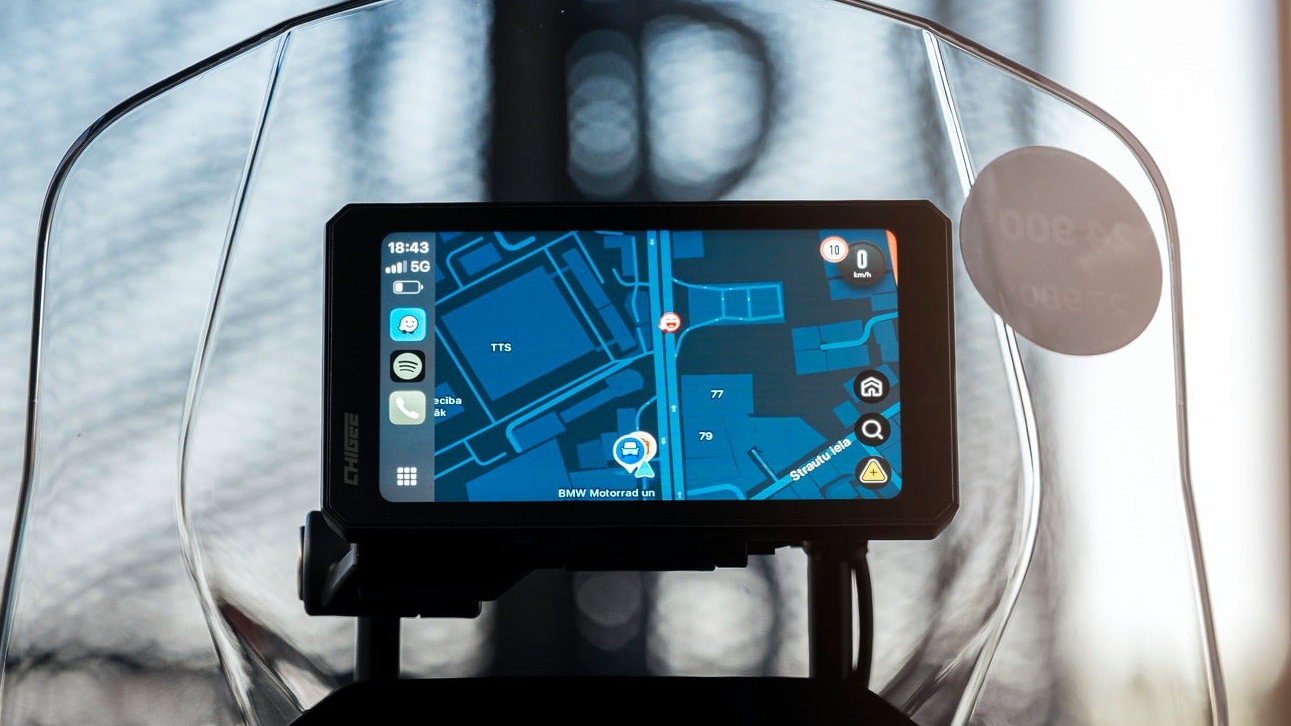
As for storage, be reminded that our favorite roads are rarely near, um, anything and that means data access can be sparse. Assuming we've made up our mind about which navigation app we want to project to our display, there oughta be enough storage on the device to stash the map files we love. Of course, in the case of bridging our smartphones, that storage may very well be on the phone itself, solving the problem before it could become one.
Updating the unit can throw a similar wrench into the machine whereby if we take up so much space that we can't download (or install) new firmware, there was never enough space to begin with. With that, a heavy dose of micro-memory is in order. Before building the perfect interface, make sure it can handle the virtual weight of its own file structure (dem dare map tiles be huge).
Traffic and weather updates point to the same software choice logic. If it's on the smartphone, it's on the device but what if our smartphone fails? This is reason enough to explore static options specific to our firmware or some other non-mirrored, directly-housed data source.
Fallbacks deserve fallbacks deserve fallbacks (learn to read physical maps and watch the skies).
The goal in all of this is for the unit's phone display features to be better than compatible with past, present and future smartphone models. It should be able to expand on the smartphone's display quality and size without sacrificing ease of use while riding. Where performance and convenience meet, it has to deliver, else what's the point?
GPS Features Compared
Chigee AIO-6 Max - mirrors compatible navigation through wireless Android Auto or Apple CarPlay. Its 6" 1280 x 720 display reaches a claimed 2,300 nits and stayed readable in hard sunlight during the test. Maps, traffic and offline downloads still live on the phone, making this a very good display rather than a standalone navigator.
Aoocci C6 Pro - projects compatible phone navigation onto a 6.25" auto-brightness display rated at one thousand nits. Its internal GPS logs route, speed and altitude data for later playback without establishing a separate onboard mapping package. Download offline map areas to the phone before wandering out where the bars disappear.
Carpuride W712DT - projects calls, music and navigation onto its rotatable 7" 1024 x 600 display. Portrait mode shows more road ahead while landscape makes better use of camera split screen. Like the others, it depends on the paired phone for actual mapping and downloaded dead-zone coverage.
Additional Motorcycle Tech Screen Features
For sanity's sake, let's forego "intelligent" voice control and its exponentially more frustrating hands-free operation. I remember a friend chiming in on the com, asking about where the next upcoming road change was and then, in an effort to exit com mode, repeating the phrase "Hello Sena, Hello Sena, Hello Sena" some fifteen times instead of just pressing the dang button. Maybe it works for some but this rendition of The Beatles Revolution 9 is more than any tour leader should be subjected to.
Instead, let's focus on what we can only hope the firmware is ready to handle.
First and foremost, that "save those last however many minutes of perfect riding" is paramount. Hardwired cams, always at the ready, keeping track of our best moments? Priceless.
This also points directly at storage capacity. Any video worth watching is going to come with a file size tax and the only remedy is removable peta-tera-giga-mega bytery in bulk. Furthermore, the quality of that removable storage needs to be of high enough caliber that jostles, bumps and mushroom clouds don't contaminate the evidence.
A data-free, fully updatable and locally hosted base map for more remote activities is also essential to the unexpected. Sure, our phone-to-device interface is a great default but there can (and will) be times when phones fail. Having an 8-bit Pac-Man version of "get me back into what resembles society" means more peace of mind.
Bluetooth connectivity oughta be state-of-the-smart as well, 6.2 being this article date's most current. Some of us are audiophiles and some of that sum use 24-bit, 48 kHz streaming software, not that any version of BT can handle it yet. Either way, as the signal evolves, so does the need for hardware that can transmit and receive it in all of its "go fast" glory.
This is where my original outline told me to discuss battery life. At first, I figured there's no need but the truth is the unit should have some kind of power storage buffer for more reasons than none. While whatever motorcycle tech screen we choose might best be connected via hardwire, it should also be able to operate independently of any direct source, for reasons included but not limited to:
- Engine Cutoff - Just because the bike ain't on doesn't mean we're not trying to get our navigational bearings.
- Power Spike - Cushioning what's between the lightning and our circuit board is a no-brainer.
- Walk of Shame - Outta gas with no reception? First off, don't do that but do pull the unit and get ta steppin'.
Ease of installation and user-friendliness is a bit of a thing, too. One can only hope that the hardest physical part involves splicing wires and connecting to this bare wire power hub. The rest deserves nothing more than double-sided VHB tape, a handlebar clamp and whatever connector geometry fits.
There may be one, ultra-chic, uber-sophisticated champagne request worth groveling for if we can get it. That is the ability to receive, program and emit garden-variety wireless communications. An IR recorder for our garage door, wireless heated gear controller, maybe even a message changer for some ridiculous backpack ... gotta wonder if we can have it all.
Additional/Bonus Features Compared
Chigee AIO-6 Max - brings four physical buttons, optional quick release and control links for compatible GoPro or Insta360 cameras. The phone reconnects automatically after initial pairing while the Chigee app handles settings, footage and updates. There is no internal battery, so the hardwire remains its heartbeat.
Aoocci C6 Pro - adds auto brightness, 5GHz Wi-Fi transfers and simultaneous phone-plus-helmet Bluetooth routing. Its wired remote handles emergency clip locking, calls and music without asking a winter glove to peck at tiny glass icons. The unit also logs GPS ride data but carries no useful walk-away battery or native maps.
Carpuride W712DT - has the most physical flexibility thanks to its rotating display, detachable anti-theft bracket and wired camera controller. Bluetooth helmet audio and front/rear split screen round out the practical tricks. Dual power options help installation but neither one turns the screen into a battery-backed hiking navigator.
Motorcycle Tech Screen Durability And Resistance
The Grand Canyon may as well separate what is a motorcycle ride from what is a self-guided museum walking tour. We're accelerating, braking, leaning, swerving ... exacting our focus on all things immediate. There's zero time for concern about the many products we invest in, which is why we learn all we can about them before making the buy.
For third-party motorcycle display hubs, we need to win every battle against water, dust and physical shock. That means ingress protection (IP) codes, the IEC rating system for how well an enclosure resists solid particles like dust and liquids like water. Their example translations go something like this:
- IP67 = dust-tight, survives brief immersion, typically 1 meter for 30 minutes.
- IP68 = dust-tight, survives deeper/longer immersion but the maker defines the exact depth/time.
- IPX4 = splash resistant.
- IPX5/IPX6 = resists water jets, rain and spray.
- IPX7/IPX8 = immersion rated.
The first digit is dust protection. The second is water protection. An X means that part was not rated, not necessarily failed.

Realistically, IP65 is plenty good at standing up to the elements. That's just about what a motorcyclist can expect from either a southwestern dust devil or a pressure washer set to "rinse". With those concerns out of the way, the real trick becomes shock.
Cameras are fragile. Action-intended or not, the actual "eye" that takes in the information we wish to record, along with all of the circuitry involved, is pretty sensitive to sudden jarring. Every dedicated "go for it" data device, especially of the camera variety, averages a half-life of two years before the input/output quality begins to degrade.
Manufactured solutions continue to improve, as systems get jacketed in robust metallic shells with space for a flexible shift/rebound "suspension" within.
And let's not forget about that giant ball of fire in the sky! For my X-Mount people out there, remember leavin' your phone on the bike in the summer sun because you were "just gonna be a minute" only to come back to a molten and misbehaving display? All the more reason to purchase something that's designed for our intended use, rather than take phone calls while doom scrolling Instagram.
Longevity, reliability, resistance to weather, vibration and impact ... all of these are important when considering which motorcycle tech screen is best suited for what any sport touring rider can throw at it.
Durability & Resistance Compared
Chigee AIO-6 Max - carries a claimed IP69K rating for the head unit while the optional cameras claim IP69. Tested through a hard rain, droplets could trigger the capacitive screen until touch lock stepped in. The quick-release contacts developed cleanable verdigris when left uncovered, so the supplied cap deserves more respect than its size suggests.
Aoocci C6 Pro - carries an IP67 claim with an operating range from 14°F to 140°F. Its current package uses an aluminum bracket, ABS/PC enclosure and wired control for gloved operation. Those details answer rain and dust on paper while long-term vibration still belongs to future owner miles.
Carpuride W712DT - publishes IP67 protection and a -4°F to 176°F operating range for its detachable unit. A hands-on reviewer used it through rain, hail, mud and wet-glove operation without losing control of the screen. That is stronger weather evidence than a product-page shower scene, though years of camera and cable life remain unknown.
Customer Support (Have Warranty, Will Travel)
Twelve months oughta suffice, so long as it doesn't include day-of-expiration booby traps. Who offers that warranty ... that's the catch. Be it the motorcycle tech screen manufacturer, reseller or third-party, we want whatever confidence they're selling to live up to the pitch.
Always read up on who's resolving matters, how those resolutions work and whether customers who needed to employ warranty claims were satisfied with the outcome. Case in point, what is a forever, no questions asked, walk-in-walk-out exchange can evolve into a big "sorry but the product doesn't exist anymore" vaporware scenario (Craftsman). That stated, our RoofPax tire inflator has burned out twice, the company pleasantly providing us with a brand new one without requiring us to return the old.
This gets into the availability and quality of technical support. Not all call automations are created equal. May as well call the number pre-purchase and test the waters:
- Does the phone number reach an actual human?
- If not, how long does it take to reach someone?
- What information is demanded of me before I'm able to communicate my issue?
- Does support sound as if they're in a rush to inform me of their inability to help?
- Is there a service charge to put the warranty into practice, meaning return shipping and/or processing fees?
Also, there's the manual. An overly informative manual beats vague every time, even if it's telling the same story in seven different languages. May as well admit your interest in learning Cantonese in hopes of getting to ride there!
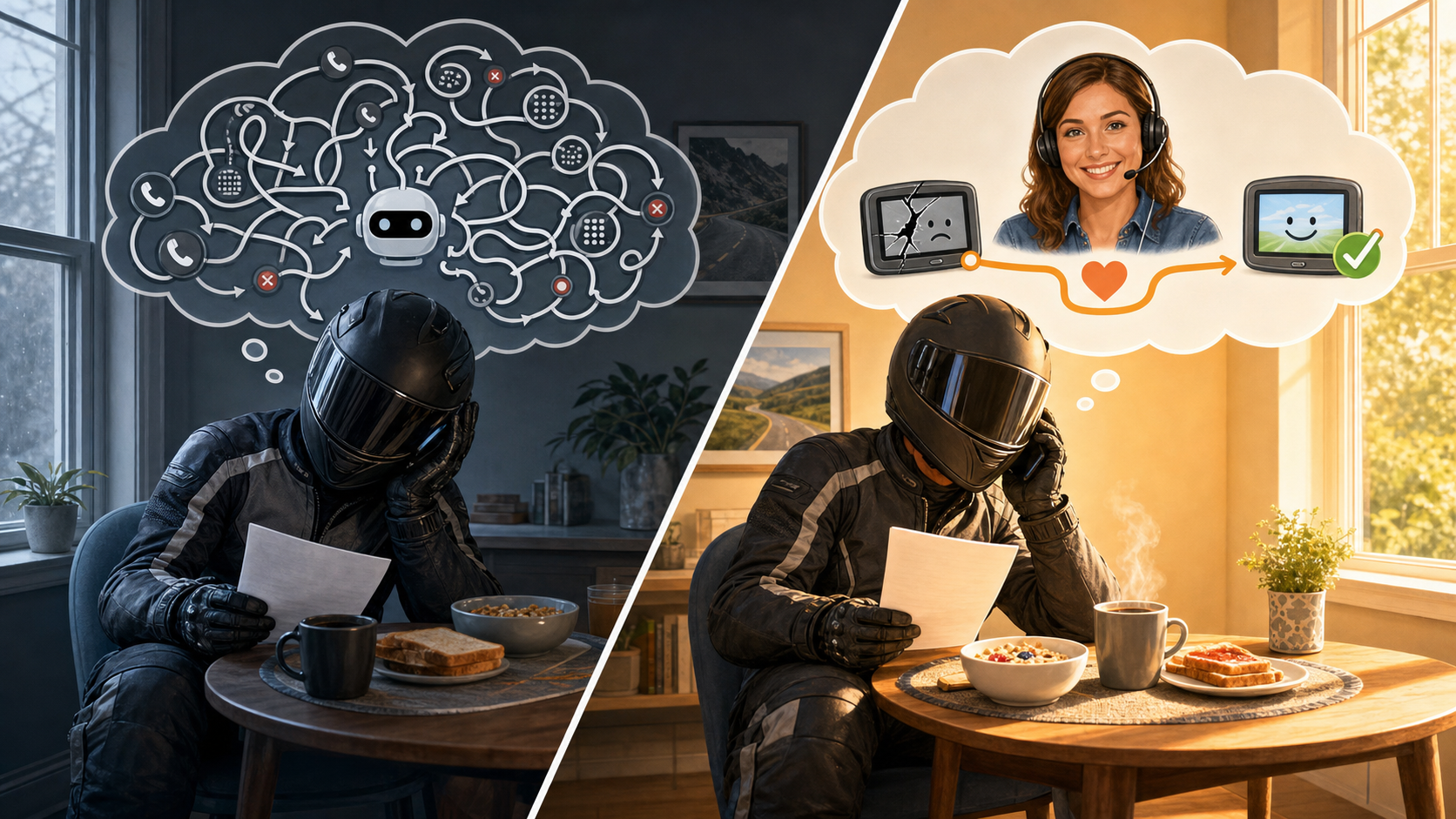
Honestly, it's the user reviews that do the most dirty work. You might find it disheartening to read five ultra-simple "great product, great seller, bye!" reviews only to then learn several new ten-dollar words from the doctoral thesis of one less-than-satisfied and eloquently articulate consumer. The trick is to keep it all in balance by first viewing the overall rating and then observing six total reviews of general usefulness (three positive, three negative).
But then, maybe the overall is enough! We pull the trigger, wait a day, unbox our motorcycle tech screen and then learn there's simply no fitting it on a Honda Monkey. Yeah, well ... if the dance steps between return policy and after-sales service are more complicated than those of Zaouli, maybe it's worth rethinking.
Spare parts and accessories are a gold mine of good times if the optimism can carry it. Maybe accessory upgrades could mean improved cameras, more accurate TPMS modules, even model-specific/direct-to-bike interfacing. Big picture made small, however, the real deal is in those darn jewelry screws and spring-loaded power buttons, so find out what happens after what we wish wouldn't ... does.
Warranty/Support Compared
Chigee AIO-6 Max - has established distribution, replaceable accessories and a detailed online support library. There are plenty of distributors and physical shops, a sturdier trail than most screen brands leave behind. The US-facing manufacturer warranty term is not plain enough to quote confidently, so confirm it before paying for a complete camera-and-TPMS package.
Aoocci C6 Pro - publishes a twelve-month quality term plus a claimed 24-hour response route. Aoocci boasts product support and an ordinary return path through its retailer. Aoocci's current site sells accessories, publishes direct contact details and gives this lower-cost box a better trail than its price might suggest.
Carpuride W712DT - publishes a two-year warranty and thirty-day return term on its current direct product page. It shoulders a much deeper owner-rating trail than Aoocci's exact listing while the maker sells replacement sensors, mounts and cables. Its disclosed hands-on review was manufacturer-supplied, so the functional demonstrations carry more weight than the cheerleading.
And The Winner Is ...
The sum of all priorities that inspired this motorcycle tech screen write-up lands on one word: consolidation. Sure, our unique-to-us feature prefs are important, in this case taking aim at modern sport touring standards in the form of GPS, TPMS and cam tech. But the subconscious elephant in the room, now clamped to our handlebars, longs for a single/compact unit where all of the information we may want is presented safely, efficiently and effectively.
This one item, with its easy-access interface, may read to some as a distraction rather than augmentation. There's a trick to that, namely keeping it out of our sightline but still useful at a glance. Remember, it's not what we do ... it's how we do it.
Future trends may arrive at miniature projectors and heads-up visor displays, though most of us much prefer keeping the data out of view. Funny how emerging moto tech and conveniences tend to do better when whatever they offer keeps the raw energy of the motorcycling canvas clear of debris. Mid-ride popup ads, anyone?
Anyhow ...
The Chigee AIO-6 Max wins overall because month-long testing and Chigee's own retro-save instructions give us the strongest combined evidence. Its bright screen, physical buttons and polished behavior create less mid-ride friction than the cheaper kits. The catch is a less wallet-friendly complete-system price against two packages costing less than one-third as much.
The Aoocci C6 Pro is the value winner with two cameras, TPMS, controller and storage already in place. The Carpuride W712DT costs ten dollars more and buys you a rotating 7" display, a deeper owner trail and the clearest on-camera demonstration of manual clip locking. Aoocci wins the spreadsheet while Carpuride makes the stronger case for riders who want a larger screen and more direct real-road proof.
None of these boxes stores a fixed fifteen-minute rewind or provides trustworthy native offline maps with a useful battery buffer. Their save buttons protect the active one-to-five-minute loop file, which is genuine retro-save but deserves that honest limit in bold mental ink. Pick Chigee for polish, Aoocci for complete-kit value or Carpuride for the big-screen middle ground.

What Motorcycle Tech Screen Do You Recommend?
New motorbike display hubs keep popping up. Which one(s) do you prefer and why? Your input is invited. Leave a comment and/or write an article!
Share Link ...

About Robin Dean
Motorcycle advocate, enthusiast and traveler. Founder, The Riding Obsession (2014). MSF RiderCoach credentials: "loosely regarded adult supervisor, probably good enough for rock 'n' roll" ~ Tidal Playlist | Rabid Neon



Thoughts gone wild? Write an article!