
Tag along for our FTC disclosure saga here ...
Line Art
Team TRO welcomes Jess Ponikvar for Line Art, Hayabusa manners and finding the fun at a calmer pace before scraping away stubborn gaskets. Music by Rabid Neon and Otis McDonald. Download our feed here.
Transcript
As legible as we are intelligible ...
Brian: In this episode, we're going to bust out the coloring books and work on some line art, meaning when you have to dial it down, how to keep smiling. Also, Brian's Tiny Tasty Tooltips is barely scraping by.
Robin: And before we begin, I want to welcome our guest co-host, Jess Potikbar is joining us today, and we're really glad to have him. I should probably elaborate on how I know Jess.
Jess: I think I met you on a platform called Ninjam. Ninjam was a platform that allowed people to jam online. And I think that's where I met you and you ended up being one of my contacts in my social media and then social media scraped my email inbox and that's how I sent you an invite. I think it was that long ago.
Robin: We used to play so much music into the wee hours of the night and Ninjam, for anybody who's wondering, it's a heavily buffered but time-synced way to play music with people in remote locations. You've got all this distance between you that even the electricity takes a little bit too much time. I hit the snare and it doesn't really hit the pocket. So what do you do to make up for it? You add actual metronome beats and buffer the audio in place, the drummer starts playing. You don't hear him for, say, four bars, and then you begin playing, and the music just sort of blossoms in the strangest ways. That's how we met. Now, so you were never in Chicago.
Jess: No, I was never in Chicago, but I do remember that drummers were very rare on Ninja. There were a lot of guys like me with a drum machine, but actual drummers, there were not many of them. It was a lot of fun.
Robin: Welcome, Jess. Real pleasure to have you here. In your honor, this round, the random song of the minute brought to you by Jess Panikvar is Till I Collapse by Eminem. If you want to hear our random songs of the minute, visit radio.tro.bike in your web browser and check it out. So look up WAX808, one word, WAX808, just like you hear it. And make sure to check his stuff out. All right. So Jess is going to hang out with us. What's your bike?
Jess: Well, I've got a couple of them. I got a BMW R9T racer, but the one I really love is Zayt. Gen 3 Hayabusa that I just, I bought it for my 50th birthday for my present for myself. So I really love that thing.
Robin: Isn't that a great bike?
Jess: It is a wonderful machine in C mode, in A mode. It's terrifying as soon as you get on it.
Brian: That's what you signed up for.
Jess: It's confusing when you start going really fast on it.
Brian: We were on a vintage Suzuki ride. And for some reason, there was somebody's, friend there on a Hayabusa. And he was talking to somebody else. And the other guy said, so how fast are you going back there? And he's like, I don't know, man. I was going boosts of speeds, man.
Jess: That's hilarious.
Robin: Well, you guys ready to rock some news?
Brian: Absolutely.
Robin: First one up, a helmet camera that tells your fingers it is recording. Akio is bringing its new 7-Eleven Air Helmet camera to EICMA. And the useful part is not another resolution contest. The company says the camera weighs about 2.8 ounces, records for 8 to 10 hours, and uses vibration to confirm power and recording commands. That means a button press should tell you whether the thing actually started without making you take off your helmet or hunt through an app.
Brian: Nice.
Robin: Those runtime figures are manufacturer claims, not results from the road test. The best ride camera may be the one we stop fiddling with. A full day's battery and a positive recording signal could matter more than movie trailer footage when the real goal is documenting a close call. Would you rather carry the camera on your helmet or wire a permanent recorder to the bike and never charge another gadget?
Brian: The word for the day is haptics and the idea of automating more so you don't have to monkey with your electronics. As I understand it, you've installed some things. You've got some wires tucked.
Robin: Yes. Wired is my favorite anymore i got some cameras going on right now they're completely wired in
Brian: Next up we have a cherubus puts the rain layer on whichever side makes sense, what a concept a cherubus has unveiled a revised sport touring jacket range, what they call it the opal and it has a practical answer to an old roadside nuisance, it has a removable waterproof layer that can go inside a jacket or over the outside.
Robin: We talked about this last time right like it's better more accessible to be able to wear it outside because then you're not wearing a soggy rag.
Brian: Yeah, I don't want to wear a soggy rag. And I think Revit has some stuff. So it's sort of, the idea is sort of trickling out that maybe people don't want to wear a clammy shell and ride around with that. It has all the jacket stuff, ventilation zippers, outlets, level two armor. We love to see that. An optional back protector. The European listing shows December 3 availability. We do not know when this is coming to the U.S., but it's an interesting idea. So the question is whether a modular jacket actually saves any packing space and aggravation compared with a good jacket plus a separate rain shell. Hard to tell. But it could lead to a world where it's easier to change in and out of your rain gear while you're standing beside the bike and you're half wet already without hopping around too much.
Robin: The first jacket I bought when I was a brand new rider had this feature. That would have been 2011, I think. And it was a beautiful leather jacket from india that had an interior rain shell that you would remove and put on the exterior
Brian: Yeah and the idea of putting your rain jacket on the outside and again frog dogs there are any number of rain jackets but selling it with the jacket i like it.
Jess: If it had an airbag that would be really cool something that would combine all of those things i'm big into airbags these days
Robin: And they're getting better and more affordable all the time so it's like that integration could save the day
Jess: Yeah it should a rain jacket should have the flexibility to accommodate the expansion that an airbag jacket would have. I think it would work.
Robin: What did you say last time, Brian? It's like we're still in the tundra with things like this, with this and displays. It's like we got new territory ahead of us that we can work with.
Brian: Yeah. Yeah, I think in about five years, it's going to be really, a lot of this stuff is going to be really solid and settled and hopefully not 900 bucks for an airbag. You know, we're getting there.
Robin: Honda brings stop and go cruise control to the motorcycle conversation. Now, this one interests me because my bike, they offer, well, it's third party. Think about being the person who designed this. A third party was willing to insure their own product It gives your GSX-8R cruise control. And I imagine that works for any of those motors. That motor is in like six bikes now. The new V-Strom has it for Frick's sake. So here we go. Honda's bringing stop and go cruise control to the motorcycle conversation. Honda announced Sensing Ride, a new radar-based rider assistance package, debuting on the 27 CRF-1150L Africa Twin Adventure Sports. Front and rear radar feed the system, and combining adaptive cruise control with Honda's dual-clutch transmission adds stop-and-go assistance for slowing to a stop and starting again in traffic. The announced functions also include group ride assist and emergency brake assist. That brake assistance operates under the rider's brake input. It's not a promise that the motorcycle takes over every emergency. There is a real touring problem here. An enjoyable day can end with an hour of stop-start traffic and a tired rider.
Brian: You know, if there's anyone that can make this work as advertised, it's Honda. Whether it's actually something you would want on your motorcycle is a different question.
Robin: Yeah. Who leads the question? Jess, you said you have the Busa. What else do you got?
Jess: It's an R9T racer. So it's like the 2017 Cafe racer. I love it. It's a great bike, and they will never make another one again. The designer of those original R9Ts is a guy named Ola Stenegard. Ola is, I believe, after he left BMW, went to go be the designer for Indium.
Robin: Oh, God.
Jess: Those R9Ts were created very quickly and they were engineered to take advantage of the glut of the 1200s. They were not able to be used in the EU anymore because of new standards. And so they were making all of these just to push them out there. So the design is really aggressive on those older R9Ts. I absolutely love them. And they're a bargain still. I mean, the racer is hard to find, but those other R9Ts, I think they're better than a lot of the new BMW, whatever the new replacement is called.
Brian: I love me a naked bike.
Robin: So they parts been the motor, like get anything with handlebars around that engine and get those out of here. Was that the vibe?
Jess: I think so. I think that it was, I think it was supposed to be just a simplified stripped down version. And I used to have an 1150 RT and I love that thing, but it was over-engineered in so many ways. It disappointed me. The brake, the ABS disappointed me. The headlight disappointed me. They're the old cop bikes, right? With the huge headlight had a ground to go bad on me once and I had to go in and fix it. That was an absolute nightmare. A fuel quick disconnect sprung a leak on me one day with a high pressure line spraying fuel all over the inside of my fairing
Brian: That's always fun.
Jess: Yeah that's fun all of those engineering disappointments i have not seen on the r9t the worst part about it is is changing the battery because i have to pull the tank
Robin: Party on was up a hex head
Jess: It's a hex head it's oil cold
Brian: And to be clear this is the one the racer is the one with the little kind of weird bullet fairing.
Jess: It's got a little bullet fairing and it also doesn't have as good it doesn't have inverted forks like the other r90s do that's the one thing about it is it doesn't have quite as good a suspension up front they opted for a vintage look
Robin: I never even noticed that huh
Jess: But it's a great bike. I mean, I get so many people talking to me about it anytime I'm on it, and it's a very uncomfortable riding position, but I'm used to it.
Brian: You tolerate it.
Jess: It's not far from the Hayusa. I mean, it's like doing a plank.
Brian: What kinds of electronics controls and limits and mappings and so forth does the Busa have these days? And do you notice them? How is it riding with those? How is it managing those on something with that outrageous amount of power?
Jess: There's a lot. First of all, the riding modes, the A, B, and C mode. Which you know c mode is more for in the rain and in the city and that's where all of the throttle positions are lowered a bit i think it's around 30 a mode is the crazy mode and then there's all kinds of stuff in between there's a wheelie control there's a variable lean angle traction control which i guess is pretty nice And then there's all kinds of other controls on there. You can set a speed limiter if you wanted. You can set an RPM limiter if you wanted to let somebody else ride your bike and you don't want them to do something really dumb on it. Personally, it's a very, very easy bike to ride. It's just like anything else with a lot of power. You're not going to go step into the throttle on a Tesla because you know what it's going to end up doing if it's in sport mode. Same type of a thing, as long as you're careful with it. But it will surprise you pretty quickly. And honestly, I like all those riding controls compared to, let's say, a first-gen 1999 BUSA, which, you know, has none of those things and it's all up to you to just be incredibly careful on it. Older sport bikes, much more terrifying when you're on them, in my opinion. The BUSA is great and I love the cruise control and they keep making certain improvements on it. So the 20, I've got a 2024 anniversary edition. The 25s have, and the 26s have a different level of cruise control. When you get back on the throttle after shifting, the cruise control stays the same as before you shifted. So it's really nice. And I got a lot of small towns around here. And that's really the only reason to slow down a lot of times because there's not a lot of traffic. But that cruise control is really nice to just kind of go, you know, 25 miles an hour through those towns.
Robin: That's a great report on a bike that we really haven't discussed that often just because the connotations that come with it. I know so many riders of the Hayabusa that are legit, yourself included. So to bring the reason that you chose it to the mix is something I think more people need to hear. Yes, I would imagine that it surprises you mostly when you look down and realize how comfortable you are. What pace you're traveling that's a big thing is that it's just planted at speeds that are uncommon for the sensibilities of many i really like what you were just saying about the responsibility involved the skill set involved it's sort of like it's probably good that you can set rpm limits or speed limits i've got level 1a 2b 3c 1a on my 800 feels like a light switch on the fuel. It's just on and off. There's no, like, if you don't have a smooth left hand, you're going to have a rough ride no matter what.
Jess: One of the things that people were complaining about the third gen Hayabusa is a little bit of play in the throttle, that it wasn't completely tight when you just wiggle it. And from what I understand, that is an engineering decision and it's made so you feel a little bit of that before the throttle starts to activate, which I thought was pretty interesting. I think I really love about this bike though is in the twisties, I really don't leave third gear a lot of times. 23 miles an hour, up to 125 miles an hour in third gear. So really, there is no need to downshift, to upshift. I do a lot because it's more fun. It is really nice to just be able to, it's kind of like riding a big scooter through twisties at those speeds.
Robin: Have you been to the track yet?
Jess: I have not been to the track on it yet. I would really like to take a drag racing just to see what I could get out of it. I think that'd be fun, but that's a whole different game.
Robin: One of the things we do regularly at a circuit track for at least a session, pick a gear. And once you're in that gear, stay in that gear for the entire run and practice just that. I promise you third gear is going to be
Jess: Your whole world. I would love to ride on a circuit sometime. Most of my experience is on back roads. And most of what I'm doing the whole time is looking out for deer and bears. And I've got a picture that my wife took because she was behind me in her truck and I was riding pretty slowly. It was right along the Columbia River and a bear is running alongside me along a section of the river where he didn't have anywhere to go. Big rock wall on one side.
Brian: Yeah.
Jess: Guardrail on the other side. And so he's just running, trying to go straight and I'm trying not to scare him. So I'm slowed way down and we end up kind of right next to each other.
Robin: Yeah. Look at each other and they're like, you're going to go? You're going to go?
Brian: After you, after you. No, sir. No, after you. I'll also remark that I'm looking at Suzuki's website, the blue color of the current 2027 Hayabusa. That's very nice. I have no idea what color yours is.
Jess: Black and orange. It's the 25th anniversary edition. And so it's black and orange and it's got a pretty aggressive look to it. I really love it, mostly because it's very high visibility. I wear a white helmet almost all the time in town. I don't know if you guys know this, white helmet, 24% less chance of being injured in an accident.
Robin: You are in the right company for that. You guys want to have some fun with some questions from the wild?
Brian: Absolutely.
Robin: If you would like for us to field your questions, please visit email.tro.bike in your web browser. Send us a message. We'll do our best to mangle the response. Luckily, we have Jess here. First question. For a two-up trip, is renting an unknown bike riskier than buying another project? Ryder planning a road trip with their wife already owns a track-prepped SV650 and a DRZ400. I don't know if that's the injected one or not, but neither seems practical or comfortable for this two-up trip. They are weighing a peer-to-peer rental, an Eagle Rider rental, or buying an inexpensive used V-Strom or Bandit. Bandit would be the way to go, and spending several weeks sorting it out. The peer-to-peer option raises worries about unknown maintenance and a breakdown far from home. They hope the commercial rental would offer more accountability, but the price and accidental damage language give them pause. Buying would allow a thorough inspection and repairs, but it would also add another project and another motorcycle to the maintain. I'm going to say add the bike. Add the bike to maintain. pain. If you don't have anything that serves the purpose of writing two up, get something that she's going to be comfortable on and then go see the world.
Brian: Yeah, I've, As someone who's rented a bike several times, yeah, this doesn't really make any sense. Where it makes sense to rent a bike is where you're traveling somewhere that you need an airplane to get to. And then you come off the airplane and then, hey, I've got my helmet. Where's the bike? And I'll also say per day, it ends up being pretty damn expensive, even if you're not renting a high-end bike. I have also found that maintenance can be variable. haven't had a problem, but you know i've had a couple that have pretty rotten tires on them and maybe that's just for my bottom feeding habits of picking a cheap bike and so forth, i'd say in this situation yeah it makes sense to buy a bike get it up to snuff to your standards, the choices raised were vstrom or bandit and either one of those would be an absolutely fantastic choice but the vstrom is also the good answer as well there are a lot more of them they are owned by middle-aged men who, take really good care of them and load them up with luggage and stuff like that, so and so they tend to be cheap they tend to be pretty well maintained and they're everywhere so and they do work well it's a large bike it's a ring you know whether you get a 650 or 1000 or even one of the newer ones, they're a large bike plenty of passenger room and a rider community that can solve any problem you have. In the Bandit, there aren't as many around. And if you want luggage and things like that or upgraded suspension, it's going to be a little harder to find or you're going to have to buy it. Yeah, either one of those. Great choice. Find one near you, get it the way you want it, and go ride places. Renting makes sense if you're traveling, but it doesn't make sense to, you know, rent for a trip from where you live. The next question, when does winter riding become a road condition decision instead of a gear decision? So a rider in the northeastern United States is considering continuing through winter. They already know about heated gear and wind and hand protection. The real question is what happens when the tires meet the road. Do other riders keep the same tires year-round or change them for winter? And do they ride when snow, salt, or sand are present? Or do they wait for roads that are mostly clear and dry? They also want to know what seasonal riders might overlook when conditions change. I would say I can dress and I can find gear to work at any temperature. I rode to work at 17 below one day just because I could. So you can figure that out for any temperature. The one thing you cannot figure out is ice on the road. That's a hard stop I mean reduced traction Is not zero traction yes But. There are people who will try to stud tires. If you look on ADVrider.com, there's a thread every fall where people are kind of looking up the arse of a long winter and considering, well, maybe if I stud my tires, I can get by. There are people who are dark siding with a snow tire. There are ways to do that. It's like anything else. You have to figure out your personal limits. My personal line is, yeah, I don't want to be in a situation where I'm seeing all ice or where I'm seeing unknown ice, black ice. There's a condition where you might, where it's cold enough and it's been wet enough, you might see ice that you don't see. Let's put it that way. And that can be very bad.
Jess: That's what we're getting to right here this time of year.
Robin: Do you have three seasons or four?
Jess: We have four seasons. But, and there's a dude in my town that used to anyway, I haven't seen him for a while, but used to ride downtown with a DRZ with chains on it all the time. I might try it if I had a Ural or something with two wheel drive. But even then you're dealing with cars that are sliding around. Funny thing is, is when I brought my Hayabusa home, it was in March. I live on a dirt road and it was really hard. I had to ride it over a patch of ice to get it back to my house, to just get it in my garage. And I was so stressed the whole time that I was going to drop the thing. but I think when it comes down to cold weather riding for me personally, because I've had to do it for a while. There was a long time when my only real source of transportation when I was younger was a motorcycle. It comes down to the fairing on the bike. It helps a lot to deal with the cold. So that old 1150 RT that I had was amazing in cold weather. Or if it's raining out. One of the things to be most worried about are leaves on the ground when it gets cold. So up here, a lot of the maple trees and things like that will leave large sections of leaf that are on the ground. And as soon as they get cold, like if it's frosty in the morning, they turn very slick. That's something that's gotten me before too. As far as tires go, as long as they're relatively new, I feel fine on them. But I'm with Brian. I don't like to ride in anything where there's going to be snow or the ground's, you know, frozen.
Robin: My chime in here then is the motivation. I remember when I first had an XS400 RJ Seca, a 1982 bike. I was so excited. This was 2011. That was the bike I could afford. I couldn't help myself. It was like peak winter in Chicago. We had low snow and I wanted to ride. And there's video just ice sheet after ice sheet. And I'm so dumb. I just don't know. I think my happiness got me through the ride.
Brian: Your sunny attitude.
Jess: My father-in-law is somebody who used to ride all the time in the snow. He's nuts. He's in his late 70s now. He's got three bikes. He still rides all the time. I still remember a time when my daughter was two years old, and I needed to come to a family event. They live a little ways away, about 45 minutes away on a highway. I didn't have anything but my bike. And he goes, just pack her on the front and just ride her out here. It'd be fine. That's the kind of guy he is.
Brian: He'll be fine.
Robin: May we hear your heritage, you and your wife.
Jess: You bet. Absolutely. My mom's side of the family is from the Philippines. Other side of the family is from Slovenia. That's where the last name Padigvar comes from. They emigrated to Colorado in the early 1900s to Leadville, My wife is a Colville tribal member, and her dad is also a Colville tribal member and a Vietnam combat vet who was in the first cavalry. Just, it's a crazy dude. That's where both sides of the family come from. My wife and I have been together a very long time. I feel really lucky to have grown up with her side of the family that is really wild. The stuff that we've done, I remember we went up to a top of a mountain called Grizzly Mountain on the reservation. The only bike that was available for me to ride with my daughter on the front of it was an old Honda XR80 and we rode all the way to the top of it and you know shale at the top and all that stuff trying to paddle up and not even a question about safety from anybody there everybody's careful of course but not like you would expect a lot of families would be where everything would have to be just perfect to do that
Robin: Yeah we're lucky to have not known and still tried it and come back home after.
Jess: Yeah.
Robin: All right. Here we go. After years of riding, when does vigilance stop helping and start wearing you out? A rider with nearly six years of on and off experience lives somewhere with short summers and has mostly ridden in fair weather. They have started riding in colder weather to get out more often and stay consistent. But they still spend much of a ride feeling that someone is about to run them over. They know they need to stay alert. wonder whether what they are feeling is a lack of confidence. They've been waiting for writing to feel more comfortable and are asking where useful vigilance ends and constant worry begins. That is mostly, if not completely internal, your ability to bridge those two sensations as they relate to the risks you're taking by swinging a leg over the machine to begin with. If they aren't being met by reaching out and exploring opportunities to improve your skills and your ability to process the threats around you, that Is the only bridge and conduit that will bring your concerns together on this. You should be nervous about the level of stupid that is around you or oncoming or passing you. But at the same time, you should have the skills that allow you to deal with that in a way where it suppresses the paranoia that you seem to be ashamed of in the question itself. That paranoia is valid, and you need to grow from the concerns by figuring them out. Go take a class. Go get perspective. Don't just ask your buddy who looks cool to the girls at the bar to answer your questions. All you got to do is this. What I like to do is that. Go find expertise that are renowned for having vocabulary to answer this concern and ingest that information.
Jess: 100% agree. I feel like the more we ride, the safer we are in general, the more we develop our skills. After I took an MSF class, this was 14 years ago, and I really need to take another one. But after I took the advanced class, it made me much better of a rider, to your point about training. Practicing those skills, that kind of a meditation, always paying attention to safety. That's where my head always is, is how safe am I right now? How is my situational awareness? How is my positioning? And that in itself is its own meditation and is the source of fun for me writing.
Brian: This is the paradox. This person is not wrong. They are trying to kill you, and you have to accept that. But what you can do about it, you can do things about it. You can be better. You can expand your awareness. And even just expanding your skill set leaves a lot more brain bandwidth for your awareness skills, and that's a skill that you develop as well. So writing more, writing mindfully about what you're learning, what you're seeing, what you're doing, you have to grow those eyes in the back of your head. That 360 awareness, that understanding this car over here, they're going to change lanes in about 10 seconds before they even know they do it because they don't have a brain. Having more positive experiences. If your riding is, I'm going to ride back and forth to work in this city, that sucks. I mean, it's a great way to stay in practice, but you also have to fill your, internal Betamax tape with good stuff. Things where you're exercising your skills, things where you're learning and things like that. So more positive writing, write better, write more. And yeah, it's a really tough trick to get through that paradox of, yes, this is risky and accepting that risk and learning to manage it to where you can be comfortable again. Sounds like this person needs more experience. They need to develop and grow their tool set. Just sack up, bro, or, you know, take a hit or pound a Budweiser. The bro advice isn't going to work here.
Robin: The ARC is the Fisher Price of advanced rider courses, and I highly recommend that if you have the chance to take an ARC, that's the MSF advanced rider course. It is a parking lot speeds course, but you do hardcore maneuvering in that class just at slower speeds to kind of make sense of it. Upgrade from that, there's what's called the RSL. that's where the coaches get to select the exercises people that are taking the class may have some input about like i'd like to work on this i'd like to work on that and the coaches can determine what they're going to do next and that brings out some really really fun exercises from both the arc and some of the intermediate rider course from that you've got total control where you can learn all kinds of dictatorship level here's how you do things here's how you don't upgrade from that. You're getting into track days and let's all learn how to negotiate at high speeds when you can see the eyes of the person next to you at 120 miles an hour. It just keeps getting better. But if you select something at your level, first off, you're working your brain. And second off, you are experiencing something that is outside of your comfort zone. And even then it's still better than paranoia, fear, nervousness, and concern. You've addressed it. You know what I mean? We're going to do a segment here. I'm calling this line art. This is going to be vague. We're talking about painting a line. We're talking about where are you setting up for the corner? What are you doing in the main street if you know what the next corner does? Do you need to be going nuclear quick? Is that the kind of day you're having? Are you running solo and you're having a good day so you're pushing it and you're still maintaining that buffer that is necessary? My buffer is about 33%. I try to keep 25% to 33% rule of thirds of my skill set available to me to negotiate the unexpected. Sometimes you're going to find yourself riding more mellow than you would before. First rule, mellowing the hell out doesn't necessarily mean you need to bore yourself to death behind the handlebars. I can still go through the entire ride and smile my ass off the entire time because I'm just trying to come up with as close to a Rembrandt as I can drawing where the two tires are. It takes more time and it's like, can I smooth this out? But what's the rule? Slow is smooth. Smooth is fast. So slow is fast if you just bridge it all over. The next one is governing the thrills can mean dialing it in at the throttle. What am I willing to risk at my right hand? Can I get a thrill out of that decision by itself? If you're solo, it's assumed risk. And if you're leading people that you care about or don't even care about, it can be about suppressing risk in a way that keeps the entire thrill intact.
Brian: I was in North Carolina, and we came upon the dragon. We saw the tree of shame. I don't know if you've ever been there, Jess, but it's kind of lame, but it is an awesome road.
Robin: Go on a Tuesday or a Wednesday or a Monday, stop at the entrance, and wait. And when the first car appears behind you, go.
Jess: It sounds like a nightmare. I've never been on it.
Brian: There were a couple of really pretty bad wrecks from people done dumb shit. So there were several cops along the entire length of 129 all the way into Tennessee. The cops were like, we can't shut down the road, but we can. So anyway, we need to get to Townsend. We need to get to the other side, whatever happens. So my decision that day was to stay on the right side wheel track of this whole extremely twisty, switchbacked, very challenging road. And I'm going to just stay in the right wheel track and see how big a grin I can put on my face. That was really interesting. So focusing on that precision, like I gave myself like a six inch window. I'm going to be in this little six inch window, this entire ride. That was a hell of a lot of fun, to be honest. You know, in a lot of places you could be cranking like a monster lean angle, at like 30 miles an hour, which is the speed limit. Things like that. Like in Indiana, for example, the roads come with a lot of gravel on them because we don't believe in having shoulders. I don't know if it's a religious exception or here or something. There's always gravel. The roads are always filthy, so you learn to work around that the hard way. It teaches you precision. You have to put your tires exactly where the gravel ain't. You're not going to be doing the racing line anywhere. When I showed up on a track the first time, the racing line was an alien concept. Absolutely alien. And setting a challenge for yourself. It can be a great way to do that. And looking around, plain old scenery, being a tourist.
Jess: For me personally, if I want to have fun without leaning into the bike, which is something I regularly have to do, I cannot accelerate really fast on my big bike. The BMW is bad enough. It's still zero to 60 in right around three seconds, right? It's more fun to flog around town. But on the Hayabusa, I'm treated so much differently on those two different bikes. Thank you. So people see the BMW and everybody loves it.
Robin: Yeah.
Jess: Everybody's like, oh, that's a classic bike. Hello. On the Hayabusa, everybody thinks you're a jerk or something. So the Hayabusa, I definitely focus on riding slow around town. Admittedly, a lot of it is so I can try and look cool. I will not make any apologies for that.
Robin: Why else do we ride?
Jess: Yeah. And when you go slow, everybody gets a chance to look at what you've got. So I'm happy doing that. Everybody tries to race me. And never even get close to that. It's spectacular how many people in Corvettes and Teslas try and race me.
Robin: In a straight line?
Jess: In a straight line.
Robin: Yawn.
Jess: Yes, exactly. I don't even look in their direction. They don't deserve it. I really enjoy a focus on being kind to everybody around me because the way I look at it, I'm an ambassador on the motorcycle going different places and we don't have a ton of traffic here. I try and, you know, thank you waves, nice signaling, doing things that people wouldn't expect a sport bike rider to do. Because I'll tell you, people on sport bikes here in Spokane are nuts. They're nuts. The Spokane police do not enforce traffic laws. They don't in Spokane County. It's amazing what people get away with. It's amazing how people ride around me. I'm sure you guys run into the same stuff. To kind of be the antithesis of that is fun.
Brian: That's a great point.
Robin: Responsibly spirited, finding the right road with the right opportunities to assess risk, then assume our responsibility with it and decide I'm going for it. And now and then, in fact, more than a now and then, because now I know where those roads tend to be. And even then we try to represent well by not scaring the stiffs in the area. That's their home. You know what I mean? I'm not trying to run grandmothers off the road, off the cliff, But a lot of people want the glory of that without the training involved, or at least the mindset that tries to not get in trouble or cause trouble for others. I applaud you, man. You worded all of that better than I've ever been able to by far.
Brian: One thing we talked about before is the mailbox factor.
Robin: Yes.
Brian: Even on a very twisty fun road stay aware people live here that there are a lot of mailboxes that means there's a lot of dogs a lot of kids a lot of people in, leaky f-350s around every corner you know they're in your lane, so be aware of that kind of stuff and be aware of what you look like you know you get like one dumb ass pass a day that's something worth thinking about how's this going to look? Am I just going to be slipping through and I was barely over there? Or is it going to be a big hairball moment for this person?
Robin: Truth to the concept of the conversation. I challenge you, I'm going to steer your narrative.
Brian: All right.
Robin: Here you are in some environment where you're like, no, I can't be that guy. You already mentioned one way that you're having fun. You pick the center lane or the outside lane or the anti-gravel.
Brian: The rubber band technique can work obviously in traffic it's not going to work, i think traffic is just going to suck and you're just going to have to deal with it can't think of any way to make it fun you need that hyper vigilance, Yeah, if you're kind of stuck, you can rubber band a little bit to at least create a little more room. Look around at the scenery. Make mental notes for good places to eat. I do that all the time.
Robin: You know, we're moving right along to Brian's tiny, tasty tooltips.
Brian: So this tiny, tasty tooltip is just scraping by. Winter's coming. I've got a list of things to get through. And so we're going to talk about the thing that every mechanic hates, which is gaskets. Specifically scraping the remains of the old gaskets off of your engine parts. It sucks. It's just going to suck. And it's always going to suck. There's also a risk factor that's very unpleasant. One slip of whatever you're scraping with, and you can put a big gouge in your part and maybe have an oil leak. Scraping too hard, you're using the wrong tools, things like that.
Robin: Just to use your own wrench on your bikes.
Jess: Yeah, I like to work on my bikes. I don't need to do much with them now. But my old RT, oh yeah, I overheated it once. I, you know, oil cooled, let it run in the garage while it was outside in the middle of winter. And then I forgot about it. And 45 minutes later, I go out and it's all overheated. The sight glass is clouded, oil's cooked.
Brian: Oh.
Jess: So I had a bunch of stuff I had to do with that.
Brian: Yucko. Yeah.
Jess: Yeah.
Brian: Here's how to make it suck a little bit less, and I call it the scale of scrapers. The idea here is that you have a whole arsenal of tools and techniques for getting gaskets off of your parts. And you start gentle, you start at the bottom of the scale, and you work your way up, and you stop where you're actually getting some results and making progress. So don't go straight to the Rolok disc or the razor blade and the whole, you know, that kind of thing. Start gentle, work your way up, and see where you get. One thing I will mention, is that gasket remover spray is pretty ineffective these days because the chemical that's in it has been banned for quite a while. It's the same thing as in paint stripper, some sort of heavy-duty chloride. Level zero is where you start is just try to peel the gasket off and see what you get. Especially on a modern bike, gaskets are made in layers. And so you have like an inner layer of like a paper or maybe a plastic. And then it's got kind of a soft plastic coating on both sides. And this is on pretty much every Japanese bike I've worked on. So a lot of times if you're careful and you go slow, you know, don't just go yank. You can actually get most of the gasket off, although some of that coating will stick to either side. So that's level zero. Just see what happens. But be careful and go slow with it. So level one would be a plastic or phenolic scrapers. You can get plastic scrapers from Harbor Freight anywhere. they're cheap and they wear out. Try that and see how far you get. Phenolic scrapers are, it's kind of a very, very hard polymer plastic. And it's a little bit of a specialty item. You can get them on Amazon. It's a tool that's from aviation. So if you're scraping on aluminum in an airplane to get like sealer off of the fuel tanks, things like that, they have phenolic scrapers. And it's just a very hard plastic. Level two is plastic razor blades. A lot of people don't know these exist. You can get them in any home improvement store. It's a razor blade, but it's hard plastic. Enough said. Level three would be a carbide scraper. And this is arguable, but again, you can get a carbide gasket scraper, and it's got like a little triangle. It's like a right angle, and it's a very, very hard material. These can be really good at getting stuff off of flat surfaces without gouging the aluminum. You do have to be careful. You can gouge the aluminum if you really work at it, but they also don't really get into tight spaces that well, things like that. Level four would be actual razor blade, but you hold it with your fingers. And you keep it at like a really shallow angle. And again, this is going up in risk. You can risk your fingers. If you're going too fast, it can catch and dig into your aluminum and create a gouge. You can get into tight areas. They're very controllable. Just watch the angle with those things too. The other thing that happens with actual razor blades is that they can develop a burr on one edge or the other. There's like a little thin bit of metal that kind of curls up. And so if you flip it over and there's a burr there and you're not aware of it, you can create a scratch. So just keep a close eye on those things. Again, you know, there's a level of risk there, but sometimes that's what you got to do. The next level is a razor blade, but it's in a holder. I think holders give you less control. And again, this is like a Home Depot scraper you might use for paint. The holders give you a little more leverage. The risk of gouging goes way up, in my opinion. And the last level, I call it level 1 million. It's a last resort. Sometimes you got to do this. When you're dealing with vintage bikes where the gasket's been there, becoming a molecular part of your entire engine, when the gasket's been there soaking for 40 years, sometimes you got to do this. 3M Roelock bristle disc. So it looks like a brush. You run it in a die grinder. There's also surface conditioning discs. And these are abrasive materials that require a good bit of skill to use but they can be a very effective way to get old gaskets off of aluminum, the danger here is if you dig in for just a second you're going to create a divot in your aluminum your gasket surface is going to get really wavy, so you have to keep these things moving use as light a touch as possible sometimes with a head gasket for example on a vintage bike the only thing you can do is take the cylinder head to a, machine shop to have them take off a couple thou because those things get embedded and they just sit there and get into the metal somehow.
Robin: What about solvents, like a dropper made of hate that just eats the lettuce right off the metal without harming the metal?
Brian: You can definitely experiment with like a brake cleaner and stuff like that. Sometimes it really will help the gasket move. The thing I use most often is just plain old WD-40. If it's a paper gasket, cardboard, Depending on what they're made of, if you just let it soak a little bit with WD-40, sometimes it'll soak and expand a little bit. Great point.
Robin: It just came to mind.
Brian: And sometimes you can get somewhere with goof off or acetone or brake cleaner, which contains acetone usually. If it looks like a gasket that might not be like a piece of plastic, try different things. And again, start at WD-40 and then move up the scale and, see if you can get it to make a little bit of a difference. Even with all these and climbing the scale and being very careful it's going to suck if you gouge a stator cover well a little smear of rtv, i actually keep a tube of a hylomar around it's h-y-l-o-m-a-r and it's a sealant that doesn't get hard and it's proof against pretty much everything gas brake fluid ionic freeze, so it's kind of this blue goo that you can use If you really screw up a surface, you can use this and it's not going to affect your engine or get in it like RTV might.
Robin: It doesn't matter if I've got all weekend and Brian made the remark like, when do I have all weekend? Well, I can make that happen. I can make an entire weekend if I'm going to clean a gasket. I can make it an all weekend thing, but the instant I sit down, I'm like, I just want to be done. I made the time for this, but I'm just like typical frustrated me. Knowing that there's a process is kind of the game here. I want to get somebody on the show who has actual therapeutic expertise. Take any issue that needs to be dealt with, but we need to have a clear head to deal with and condense it down to the nothing that is being on a motorcycle and having high alert mode going for us, which is part of what inspired me to reach out to Jess. This guy is doing choreographed dance moves to hip-hop and house, making videos on Instagram, practicing the art of it. How did you arrive at this? And I'm so proud to know you for having done it.
Jess: The girl you see me dancing with is a professional dancer. So I was approached by somebody to do something that is like Dancing with the Stars. It's a charity event here in Spokane. Called Dances with Spokane. We basically have three online parts of a dance competition and then one coming up on the 13th year of November that's live in person. So the dance coach that I got paired up with, she does a lot of hip hop music and I'm a hip hop DJ, so absolutely love that part of it. Now, the reason I got into dance before and why I like it and why I think I'm okay at it is because I started playing a video game on the Nintendo Switch called Just Dance. And this was part of my whole fitness journey. This goes back to motorcycling. When I was, I'm 52 now, I dropped my bike and I had a hard time picking it up. I also was diagnosed in my late 30s with type 1 diabetes, right? So I'm like, okay, I need to get in shape. I need to get in shape to be able to ride my motorcycle for as long as I can and to also mitigate the effects of diabetes and have good blood sugar control and all that. So I got into working out, but I never really was able to kickstart my fitness journey until I started playing this dance game on the Nintendo Switch in the safety of my own house, much to my youngest daughter's chagrin who had to walk by all the time seeing me dance. But I really enjoy it. I love moving like that. And so I got into this thing called Dance Spokane and I've really enjoyed it. It's a little bit out of my comfort zone being put on Instagram and doing all these dances. I have a lot of friends of mine. They're not saying anything, but I can tell they're like, what? But it's been a lot of fun. And yeah, it's about to wrap up pretty soon, but I'm, I'm really glad I'm doing it.
Robin: I think it's awesome, man. And does anybody going to try to like front and step in my way of my ability to enjoy this by having an opinion? Okay. I have to supersede that. I have to go over that and land in a place that has nothing to do with their perspective on what I'm doing for me.
Jess: Yeah.
Robin: Was any of that decision based on that notion?
Jess: Have you ever heard of Dunning-Kruger syndrome?
Robin: Have we met?
Jess: Where somebody thinks they're really good at something. I think I have just a touch of it. Part of the reason why I really like working in technology is I have this relentlessly positive viewpoint of my place in the world and what I'm doing. But a big part of this, honestly, was the fact that I left my job about four months ago. I knew I was leaving the job and I needed some structure. And then when I was approached by my friend who's putting this whole thing on, she's amazing, with the help of some other people, I was like, I've got to try it. I have to jump in and try and do this. It's going to give me some structure while I'm looking for my next job, which it has totally. I don't know how much of it was this adversarial bend towards I'm just going to do what I want to do more than just kind of I'm just going to throw myself out there, see what happens with it. I've been a DJ for long enough to have stopped caring about the way that I look in front of people for a long time. And that stuff just, I mean, I can hang out in a bar by myself all night and not feel self-conscious. I've been in that industry that long.
Brian: You can do this all night.
Jess: I can do that all night. I can just go work out of a bar. I like working out of bars much more than I like working out of coffee shops. So I'll just go hang out somewhere and I feel very comfortable by myself in those situations.
Robin: Freaking awesome, man. The world needs more of that approach to anything.
Brian: Absolutely.
Jess: I appreciate it.
Robin: Brian, what? What do you want to talk about next episode?
Brian: A little bit about your conversation just now with Jess. The idea of crossovers and spillovers. What I really like here is the idea of talking about, the skills and mindsets and attitudes and whatever that you have in motorcycling, that cross over into other parts of life. Riding motorcycles makes you a better driver, I suspect. I have a much better balance than most guys my age, that kind of thing. Risk management mindset. And there are also things that cross over and spill over from other parts of life. Jess, you mentioned exercise, moving around, building your strength. That spills over back into motorcycling. I think there's a good conversation to be had there about crossover, spillover, and when motorcycling is a part of your life, what does it do and what does the rest of your life do for your motorcycling life?
Jess: That's a great subject.
Robin: Jess, thank you for being a part of this episode.
Brian: Thank you very much.
Jess: Well, thanks for having me. That was fun.
The Gist
Jess Ponikvar brings a Hayabusa with manners, a BMW R nineT Racer with uncomfortable charm and a bear that briefly shares his lane along the Columbia River. The Spokane DJ treats smooth riding as its own meditation and declines every Corvette's invitation to prove something. His fitness story eventually leaves the garage for a charity competition, with staying on motorcycles as the long game.
Robin trades outright speed for Line Art, finding the fun in a carefully drawn corner instead of another handful of throttle. He keeps some skill in reserve for the unexpected and sends an anxious rider toward proper training rather than barstool reassurance. A two-up touring question gets a less restrained answer (buy the comfortable bike and go see the world).
Brian gives himself a six-inch wheel-track challenge on the Dragon and discovers that precision can supply the grin at 30 mph. Back in the garage, his Tiny Tasty Tooltips ranks gasket scrapers from gentle plastic to powered abrasives that can turn aluminum into expensive topography. Start mild, watch the blade angle and don't let impatience become an oil leak.
Guest Host
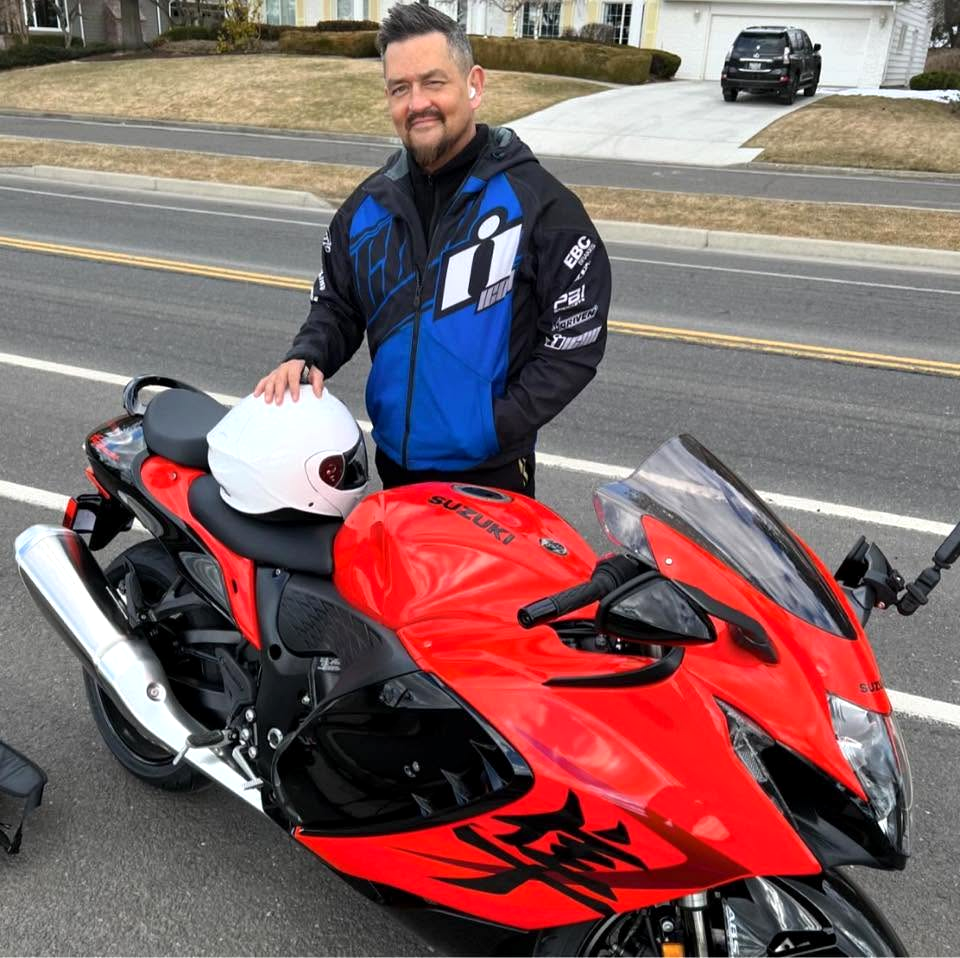
Jess Ponikvar is a Spokane hip-hop DJ who met Robin through late-night online jams on Ninjam. He rides a Suzuki Hayabusa and a BMW R nineT Racer, bringing firsthand stories about rider aids, back-road wildlife and a dance-fueled effort to keep riding for years to come.
Kit We're "Blatantly Pushing You To Buy"

Package List: The package includes 4 plastic chisels in various width sizes: 3/4", 7/8", 1", 1-1/2", A good combination for scraping, prying and Disassembles to clean a variety of surfaces. Material: Made of high-impact nylon-plastic composite material with high strength, designed to scrape and remo More ...

Bulk Value & Convenience: Includes 200 pieces of orange plastic razor blades, providing long-lasting supply for daily cleaning and replacement needs. Ideal for both home and professional use. Wide Cleaning Applications: These plastic scraper blades are perfect for removing paint, glue, grime, and st More ...

ApplicationCarbide Scraper Tool used to remove gasket residue from steel and aluminum heads, along with carbon Build-Up and even rust and clean disc brake caliper slides. Not intended to be used for scraping glass or as a windshield squeegee. Product SizeCarbide Gasket Scraper includes two blade wid More ...

Versatile Cleaning Power: Our razor blade scraper set is your all-in-one solution for effective cleaning. This non-retractable tool, featuring a rubber handle, is perfect for glass, stovetops, and windows. With 15 extra SK5 steel razor blades, it's a plastic scraper tool that never misses a spot. Bu More ...

DescriptionThese 1inch radial bristle disc kit are ideal for jewelry making, hobby and craft, metalworking, wood carving and DIY making project,bristles wheel can deburr, finish, polish, more effectively with no harm on the surface. MaterialRadial bristle disc is a new type of abrasive brush, premiu More ...

The original brake parts cleaner. Formulated to quickly & effectively remove grease, brake dust, brake fluids, oils, & other contaminants from brake parts, lining, pads. Cannot be sold for use in ca or nj. Non-flammable. This item is not for sale in catalina island More ...

Silver Seal Hylomar Universal Jointing Compound (6.9 oz. Aerosol)
6.9 oz. Aerosol Can. Hylomar Universal Jointing Compound exhibits excellent thermal and chemical re More ...

Waterproof & Windproof: APEXUP rain jacket for men features a 50008000mm waterproof coating, hot-pressed sealed seams, and waterproof zippers to help keep you dry and provide reliable protection in rainy and windy conditions. Durable & Visible: Made from tear-resistant, high-density polyester, the m More ...
Did We Miss Sump'm?
Sixty percent of the time, we're right every time. What would you add to the conversation and why? Your input is invited. Leave a comment and/or write an article!
Share Link ...


Thoughts gone wild? Write an article!