
Our FTC disclosure's magnum opus awaits here ...
Compression
Listen in as Team TRO discusses compression checks, harsh howdies and Dunlop's early arc. Music by Rabid Neon and Otis McDonald. Download our feed here.
Transcript
As legible as we are intelligible ...
Robin: In this episode, we get compressed by questions from the wild, difficult choices, jeez, the AGB, and we're going to call him William Dunlop, okay? Because I don't want any trouble.
Brian: I don't know what that means. I will find out.
Robin: Opening announcements, news corrections, banter announcements. Big comment from SC in Brisbane, Australia.
Brian: Oh, wow.
Robin: Just wanted to take the time out to let you know I thoroughly enjoyed the ruckus. He's talking about Robbins Road ruckus. This is not the podcast playlist that It is located at radio.tro.bike. That's our playlist where we talk about random song in a minute and plop that into an episode. It's actually my playlist on title, Robin's Road Ruckus, which is linked at the bottom of every article I write for the website. Yada, yada, yada, sis, boom, bah. I will say he's got some cool bikes, though. He's got a BMW S1000XR, a WR250R, KTM 640 Adventure that he's working on. Very cool. Thank you for the compliment, SC. Appreciate you.
Brian: Nice.
Robin: I don't have a random song in the minute. Again, do you?
Brian: I got nothing. Last time I recommended a cat video. Are you in the cult of Gumbus now?
Robin: I'm not doing this. No. I looked one time and then I was like, okay, okay. Now I know what that is.
Brian: All right, fine.
Robin: That is a really great thing to talk about for a split second. And then it's all about demographics. Demographics, man.
Brian: Cats are good pets for motorcyclists because they can hang out by themselves for a while. So you can be gone for a couple of days.
Robin: And they'll be a little pissed off.
Brian: It's a stretch. It's a stretch, but it relates.
Robin: I'll pull this one out. Peter Gabriel's rendition of David Bowie's Heroes.
Brian: Perfect. Nice.
Robin: If you get a chance to hear the live version, that's amazing. But the studio cut's really nice, too. It's just so well done, so respectful. And honestly, if you're riding in beautiful territory, it is a zen tune.
Brian: Not one that'll cause you to go 130 miles an hour.
Robin: More like in between the places where you would go 130 miles per hour.
Brian: You will flow and time will pass and you won't experience it. You'll be in that moment. I like it.
Robin: By the end of the song, you might be going 130 miles an hour, though. I challenge you to listen to the song with your eyes closed for the duration. Just be like, wait a minute. No, I, oops, my right hand. Accidents. Also, there's this great station. Some of these things I see on Instagram just crack me up, man. What? No way. spelled N-O-O-O-W-A-A-A-Y. Okay, this guy's fantastic. Now he starts off purely Minnesotan or Canadian. It's little things that he sees people do on Instagram or on videos on YouTube for automotive reasons. And then he's just like, come on, I've been doing this in some other way all my life that's a pain in the ass. And I could just do this. And in this one, he takes tube fuses.
Brian: The glass tube fuses, right? Yeah.
Robin: Places them on a smartphone. And you can test if it's good or not by whether or not it conducts your signal from your finger to the numbers on your dialer. Immediately, you can hear, I can hear him already. But no way. Come on, really? And he learns it. And it's great. The one I saw before this was something involving a fork. Take an old fork and you stick it between two things you're trying to hold in place on a on a car you bend the fork around it and twist it over and then you've got constant access to this otherwise enormous pain in the ass it may have been a spring clip or something like that okay just bent a fork and hooked it up i was like yeah great channel so shout out that would be a fun guy to have on the show that's something i want to work on more if i can get more proactive about reaching out to people we'll have more interesting people you got gonna hang you
Brian: And i can hang out with them. Yeah, just have a good time.
Robin: Anyway, that's all I got going on. I haven't ridden. I've been working on things that have nothing to do with motorcycling constantly. And Maggie Dean is away in St. Louis. Shout out to Maggie and her father, who is recovering from a cancer-related surgery. Shout out to him. Get well soon. We love you. All right. Brian, how are you doing, man? What's up?
Brian: I'm good. Rode for about two hours a day, but I really meant to ride for about 45 minutes. It just turned out that somebody hit a gas line on the interstate and it was all closed. Took a lot longer to get there and back than I intended. But on the way back, I headed up to Hamlin County and was able to basically rail roundabouts all the way back. So that's always fun. Stupid, but it's fun. Stupid fun. Got the fork seals done on my bike. Found out the steering sim bearings were notchy, so I replaced those two as well. They seem to be sealing, seem to be steering. Everything's good. Pretty much ready to head to the Smokies in two weeks.
Robin: Yes!
Brian: Gonna be good.
Robin: I'm happy for you.
Brian: So now I'm debating the eternal debate is to whether to throw on new tires or can I get about a thousand miles out of these tires that are on the bike? It's like, damn it. It's the eternal problem. It's never clear cut.
Robin: Yeah. Like how long have you really thought about it? If you look at it, do you see what you need? We're talking to, why don't you just bring an extra set? Your trailer in there?
Brian: Yeah.
Robin: Yeah. Trailer there. Bring the extra set. You can always do that over whiskey and wrong. Yeah.
Brian: Do it in the parking lot again yeah, I'll do some math and tread depth and figure it out, whatever. And got a conference in Ohio next week, which is...
Robin: Very good. Well, you can make an excuse of that. What you cannot ride there?
Brian: Right. I need to take all of our display and giveaways and all that crap. So I need to... I need cargo room.
Robin: You could always mail it.
Brian: Too late.
Robin: Okay, fine, fine, fine.
Brian: It's Columbus, Ohio. Not that interesting to get there from here.
Robin: I'm from there. And there's all kinds of interesting ways to get there.
Brian: Oh, yeah. There's all kinds of assholes around Columbus. From Indianapolis, there's no way to get to Columbus that's any fun unless you really dip south and take all day at it.
Robin: That is fair.
Brian: Straight east for three hours. Do not deviate. Not much fun.
Robin: Are you ready for some questions from the wild?
Brian: I am ready for questions from the wild.
Robin: Listeners all around, if you'd like us to field your questions, visit email.tro.bike in your web browser and send us a message. EB asks, is this a good compression test on this used engine? Posts video taken by a spider monkey on crack with no sound. There was a motorcycle engine in there somewhere. What else does it say, Brian?
Brian: The guy had this god-awful video of a compression test. I think it was, I don't know.
Robin: Are these my toenails?
Brian: Yeah, werewolf toenails. No. So you had this compression test, and the video didn't go along long enough. It tested one cylinder. You couldn't see anything. There was no sound. You couldn't hear what was... Anyway, but it reminded me, a lot of people don't know much about compression tests. So I thought I'd really quick go into compression test, how to do a good one, how to do a bad one, and how to film one. That's up to you, but try to get somebody else to hold the phone.
Robin: How to film anything better than what this... Yeah.
Brian: Put the phone somewhere stable.
Robin: Here is slightly half of the information for each component of this question that you need and nowhere near enough for me to be properly asking a question.
Brian: In the vintage motorcycle world, I've seen a lot of people do a lot of unnecessary work and scrap a lot of engines that should be fine because they did a compression test and it came out bad at low compression. And so they got rid of the engine or they started ripping the engine open. It's like, whoa, wait, wait, wait a minute, wait a minute. It's a simple test. Screw a fitting into the spark plug hole and you crank the engine and you see how much pressure it builds up. and it's pretty simple. But the problem is there are a lot of steps along the way, so you got to make sure you're not leaking air and you have to make sure that you kind of understand how the spec works. Every engine has a different spec and it'll be in the shop manual. The range that is acceptable for the compression reading you get. Like on a higher compression engine, it might be 155 to 175 PSI. It might be the specification. Or modern engines might go even higher. You know, it might be up to 195 PSI, something like that. And that basically means when the engine comes down, both the valves are closed and it's on the compression cycle. That's the pressure that builds up in the cylinder. So there's a lot of ways for this to fail and only a few ways for it to go right. The first point of failure is that a lot of compression testers are really crappy. So if you go buy a cheap compression tester, it may not be very good. You have to spend a little bit of money. Like Harbor Freight has a really cheap one. don't buy that one but they've got like a mid-priced one that's probably okay.
Robin: Harbor Freight good for some things bad for most.
Brian: It's kind of like well.
Robin: Let me find out how wrong I am but I feel like a good compression tester is going to be one that accepts the compression cycle and then holds that value for you to read after you Even if you go beyond it, like it doesn't get pulled back down. It goes up to a reading. And then when you leave the compression state, it's holding that reading. So you know where you were.
Brian: Yeah, that's how they work or they're supposed to work.
Robin: That's a good compression test. You're right.
Brian: The needle kind of ratchets. As the engine spins, you'll see it build pressure. And when it stops building pressure after 12 or 20 revolutions, then you're at the maximum pressure. And that's your reading for that cylinder. And there's some obvious stuff like make sure the fitting is the correct size. Is make sure it's sealing well up against, you know, you're not leaking air anywhere. Because you're basically turning your engine into an air pump and seeing how much air it'll compress. Because if you go look at an air compressor, it is an engine. It's a piston cylinder. It's compressing. It's just the valving is different and the purpose is different. One thing to be aware of is the spec for your compression is generally on a warm engine. So an engine is warmed up, it's been running. So that way you know that the rings are expanded. You know that the rings are lubricated, and it's pretty much in a running condition. So where a lot of people go wrong is they'll do a compression test on an engine that's been sitting in a corner for five years.
Robin: I mean, I guess that's good enough if you want to say, does it have compression? Okay, sure. It's got compression. Well, maybe it'll turn over. Let's find out. Yeah. Different situation.
Brian: That's the thing. And overall, if you're dealing with an engine that's been sitting a while, does it have compression is about all you need to know that's useful. The degree of compression, you can't really tell. You could put like a little tiny bit of oil in the cylinder, kind of get it around, maybe using a dropper or something. It'll seal a little bit and it'll give you a little bit better number. But yeah, don't condemn an engine just because it hasn't run in 5, 10 years or whatever. You can get a lot of good deals on engines that have been sitting around, as long as there's not rust in there. If it wakes up and runs for a while, compression will generally improve quite a bit. So yeah, you're just looking for a ballpark here if you're dealing with something that's been sitting a while. So don't get too upset if you're getting, you know, 100 PSI or whatever. Engines will run on pretty much anything 75 PSI and over. So it'll run if it has some compression. Honestly, if I'm looking at something like a lawnmower or something, I'll just put my thumb over it and crank it and see, okay, I've got some compression. Let's go on and get it running and see what's going on. Other big mistake is leaving the throttle bodies or carbs on the engine. You got to take that off. intake has to be open, has to be able to suck in air to get all the air and so forth. And the third big thing that people screw up is they use like a weak battery. You need like a really good, well-charged battery. You need to spin that bastard as hard as you can. You need to make sure you get a good, you know, something that would actually start. A lot of people will, you know, they'll pull the battery out of the corner. It's also been sitting there for five years and wonder why the engine goes whoop, whoop, whoop, and you don't get it. You know, It's got to spin quickly. And again, you know, temper your expectations. If it's an inch on a bike, you just pulled it in, it's still a little bit warm. You pulled the carbs out, you're doing a compression test. Everything's out of the way. You're using a fresh battery and so forth. That's a good compression test. And you can expect what it says in the manual. And also the other thing to look at is the differences between the cylinders. There'll be a spec for how much difference is allowed. And again, if it's an engine that's been sitting in the corner, I don't know. Don't get too worried if one cylinder is different than the other. They do even out over time. Or you could just put a little bit of oil in the cylinder so you're not like running things dry. That's probably a good idea anyway.
Robin: I used to talk about how parking the Bandit, it was something about the Suzuki thing where every time I parked the bike, it was a different bike. Different UJMs had different behavioral profiles. I know my Yamaha was always just rock solid. The Honda Hawk GT, kind of the same thing. even more so. It was like, this is always going to be what this bike does. The band on the other oil air cooled motor. And every time I parked it, I come back out and it was almost like it was shaped differently. What really caters to my experience versus Brian's greater experience with working with motors is no matter what your experience level, a certain amount of daydream level patience is what's necessary. And by that, what I mean is you're just sort of loitering towards your garage because you've got that time to breathe. The sun's out and you see the engine. You kind of look at it. You brush it off. You clean it up. You inspect everything side to side. You put on the tester. You take things slow. You don't got anywhere to be. That's the kind of mellow that I think is necessary for good wrenching to take place on a cold standing paperweight of a could be something else engine. Your perspective on not looking at the goal line so hard. Like, I got to make sure.
Brian: Yeah, did this guy sell me a bad engine? I got screwed over. I know I got screwed over. Yeah.
Robin: Take a step back. It's easier said than done. When you have an agenda, it can be infuriating. But if you treat it as something that's not going anywhere, brush some dust off, pull the plug and take your time. Eventually, it'll find its way. A dollop of oil from a turkey baser into the spark plug outlet is more complimentary to this effort than I think people might expect. What do you think?
Brian: Like not even half a teaspoon, just a tiny bit.
Robin: Just shy of a gallon.
Brian: Like it's a salad. you know oil it with put some olive oil in there maybe some 5w30 yeah don't.
Robin: Put a gallon in just a dollop
Brian: Just a tiny glug just to to make sure the metal's happy in there all right i.
Robin: Didn't prepare anything for segment one we're gonna have to use the alliteration grab baguette and that means
Brian: I need a random letter all right let's do it you really need to come up with some like french theme music say.
Robin: No more brian say no more here we go ready one a two
Brian: So it turns out if you Google random letter generator, you get like a lot of results. No. So I'm going to...
Robin: The internet is amazing.
Brian: We have the letter H, as in hatred. Uh-oh.
Robin: Well, this gets dark fast, man. Are we sure we want to do this one?
Brian: All right.
Robin: The harsh howdy. You know that writer you like to roll with is going to bring that jackass that you don't. Oh, wow. That is one of the darker ones man are we gonna go there we're
Brian: Not gonna name names and we're not gonna have identifiable details.
Robin: We're just gonna incite paranoia among those we love to ride with most thinking they're the ones and no it's not them let's just say this has never happened it's never happened but it'd be fun to talk about it could happen it is an option okay so the harsh howdy you know that rider you like to roll with is gonna bring that jackass that you don't How do you turn this would-be negative into a positive? And what makes them a jackass? So let's say you have a gathering of people with a particular posture of motorcycle. And one standout person shows up to try and turn the entire hang of multiple people riding this particular style of bike into a completely different hang that has nothing to do with this particular crowd. How do you deal with that?
Brian: Good question.
Robin: I've been trying to be more positive lately. Anything can be inverted if you try hard enough. You can reverse the polarity here.
Brian: And again, we're talking about someone that you do know brings someone new to the party and harsh is the mellow, if you know what I mean.
Robin: Even if they're trying not to.
Brian: I got a couple different things in mind I think I can anonymize.
Robin: Think of it this way. All of my friends know that I try too hard. All of them. Ha ha ha ha! And they're still like, okay, okay, okay. We'll bring him into the mix. We'll let him be who he is. We'll figure our way around it. It's worth doing. Thank you to all of those friends. It didn't change the fact that we found our way through, right? It doesn't necessarily have to be the analogy I just used.
Brian: I don't think you're that guy, no.
Robin: Could be anything. Maybe the writer's just always generally an asshole. Maybe they're a wet sock. Maybe they spin everything into a negative. Whatever it is, you got to deal with that. My immediate fix is our overspoken ride your own ride except this time you get to really really pronounce it to everybody and have a little chat and
Brian: Then you know what you do you leave.
Robin: You just go the irish goodbye vertical thinking okay That's what just walked into the situation. I can now be vertically selfish. The four feet of space around my area that I'm standing in now needs to be the most important thing to my mental health. And I'm going to find a way to word that to everyone around me and explain to them, I will be riding my own ride. Here's what I'm going to do. I need everybody to know that I'm not taking responsibility for you. I'm going to go ride. I am not going to be waiting.
Brian: There's a person that the other person brings. So one of the tactics for that, you brought this cat home, you make sure you feed the cat and it's your buddy's problem.
Robin: So what are you two doing for your ride?
Brian: What are you and your pal doing here that, you know, within five miles of...
Robin: So what is your plan for your ride that is independently situated?
Brian: I am going elsewhere, not to be disclosed. So basically yeah good people will feel that responsibility and i've seen it happen like oh good guy at work am i but he's really stepping on his yeah you know this is bad yeah good people will kind of like okay and they'll kind of shovel them off and take care of them so forth you guys are a unit now by you know so that's one thing to keep in mind you know you don't have to be everybody's keeper. Second thing I've seen happen, a spouse shows up that is 99.9999% of the time, the spouses show up, wives, husbands, significant others, and it's just cool as hell. It's great. Kids, vast majority of the time, it's great. Once in a great, great while, you'll get a real wet blanket. You know, like, I'm cold. This hotel doesn't have a bidet and a breakfast, you know. This place is a dump. It's the same tactic. Oh, I'm glad to see that you brought your significant other. You guys have fun. Here's the map.
Robin: There is one way to be a half moon in both directions, the good and the bad. You can be both sides of the coin simultaneously. You approach a friend. Okay, so here's the deal. I don't know that rider. So you two are in back. Don't mess with me on this. Otherwise, I'll go fully independent. You're on your own. And if everything goes well, cool, that's great. And then you ride along. And let's say it doesn't go as planned per se, but you ride along. Twisties, twisties, good times, good times. And lo and behold, you get to your first gas stop and you've witnessed enough to know that there's a severe compatibility issue between behavioral patterns. I've never been afraid to say, I got to let you know, we're done here. You seem like a nice person or whatever, or worse, you don't. But I just want you to know I'm not taking any responsibility for you. So I'm not going to be waiting for you anymore. You guys are doing your own thing. I can tell you where we're going and maybe I'll see you there, but you're on your own. If it's somebody who can receive that, all the better. If it's somebody who can't, all the better. Whatever.
Brian: It's honestly a very tough conversation to have.
Robin: It's ruthless.
Brian: You're better at that sort of thing than I am. Speaker of the unspeakable, robin dean you.
Robin: Got to have a very particular rhythm
Brian: Yeah one positive thing that can work is to make suggestions for alternate activities alternative routes if you can tell someone is having trouble from all the way in the front or in the middle or wherever and they're in the back and they're having trouble and so forth they're not happy they don't want to admit it you can say hey why don't you guys go over to this other road and go look at this interesting field with a cow in it or whatever bad analogy we're.
Robin: Writers with a t go ahead
Brian: So You can spin it positively. It's like, I think you might be happier over here. Here's a suggestion I have as a local or someone who knows this area. This next section gets pretty hairy. You guys can go around over here. Totally your choice. But if you go around here, you'll have a much nicer ride. And there'll be some bunnies and you'll see a goat farm. It'll be great. And you can meet us here and we'll have lunch and ice cream and all will be sunshine and roses. Because offering alternatives can be a positive way to redirect someone's energy somewhere more appropriate.
Robin: Totally can. And another one I've seen, if you're able to detect the mindset of the, let's call them the anti-writer of the group. So harsh. You paint a picture conversationally where you can see how they might think or where they might lead a conversation if you give them the mic, which you don't, and you make some statements that broadly blanket the group as a whole in terms of mentality, most of it referring to sarcastic humor involving those who don't follow the most basic writing protocols. Maybe you observe it in this rider but you couldn't possibly have seen it according to them because you're up there leading a ride but you do because you know how to so what do you say you describe a story that involves that particular problem you tell that story in a way that really just says do not step into this ring of discussion fix your shit maybe we'll keep you around you know but just basic blanket of known safety for one communal behavior to you know things to talk about things not to talk about or skill set in general what adds up what is known true to form what fits the pattern for a damn safe and sometimes super legal good time depending on your group and skill set So when you see these things interrupting that flow, disturbing that ebb, if you can conjure a creative talking point that you're not even saying directly to them, you're saying it laughing to the group, and it just happens to involve something they know that they did, and they don't know that you know that they did, that can work if you are really good with your wording and your tone of voice. All these things are ways to get around the situation. All these things are ways to try and step towards improvement. And they're all a different direction on the compass.
Brian: Definitely. And it's all part of keeping an eye on your flock, which is one of my commandments. We could go on.
Robin: No, we better not. We've both crushed three really good arguments. Let's get loose. Let's get chill. It's time for the chillest of all of us. Segment two, this round, is going to be moments in motorcycle history with the one and only Jordan Liebman. Now, based on what I learned last time, and to explain my intro, the name is William to the lot of us. Else the younger rendering of Mr. As He's Known to Others, Joey Dunlop, would show you what he was made of. Even if you were a fellow writer that he respected. Now, I don't know where we left off, but I do know that we're going to talk about one of his mentors and admired folk that he enjoyed the company of. Who he had started to overtake, still had total respect for the guy, but was ready to move on. And that's maybe where we're at. Let's find out. Take it away, Jordan.
Jordan: Another second-place finish at Cookston made 1971 a successful year. So he took two second places in 1971. The following year, in 1972, Joey married his sweetheart, Linda Patterson, and moved to Bushside near Merv and Helen. So he moved closer to his mentor, Merv Robinson, and his sister Helen. Family's really tight in Northern Ireland, and he wanted to be by them, and they lived in the same town. His first year of matrimony may have been a distraction with no racing results besides a third-place finish. He did get some sponsorship from his boss, Danny McCook. So he's still working. He's not making money racing. He's got a day job and he's still working regular. So he's got a sponsor now who owns a dealership. By 1973, Joey was given a 350cc Irmaki four-stroke single-cylinder race bike in addition to the Invader. But by now, he was up against the ridiculously fast Yamaha TD3s and TR3s, and neither bike was up to the pace. We talked about those bikes when we talked about the 1970 Daytona, giant killers. So he's racing a 350cc Air Mach-E, which in America was rebadged as a Harley Davidson, if you recall, against these Pucca racers, as they call them in the UK. Still, Joey managed to be competitive despite riding slower machines. He also made his debut at the Isle of Man, but not on the main mountain circuit, but on a short circuit track on a converted airstrip with a second and third place finish. His first attempt at the Isle of Man 1973 on an Air Mach-E 350cc single, four-stroke. And he's doing it against real racing machines. and he took a second and a third place finish in that, so that's not shabby at all. Joey preferred getting himself to and from races by himself, and He got himself to the Isle of Man on a converted fishing boat, which became one of his quirks and added to his legend. There's lots of stories of Joey getting to and from the Isle of Man races on his own boat instead of putting it on a ship and going to the bar with the rest of the guys. In 1973, Joey was also introduced to racer Frank Kennedy, also from Armoy, and racing an Air Machi 350. So both of them are racing Air Machi 350s. They must have really had a push in Northern Ireland to try to promote that brand. The trio of Dunlop, Robinson, and Kennedy later became known as the Armoy Armada. The three raced, each taking turns beating the others. By now, it was clear that Joey was the equal to his mentors. By 1975, four other riders from the county down in Southern Ireland, headed by Ray McCulloch, became known as the Dromara Destroyers. Their rivalry was about to become the golden age of Irish racing. So this is pretty much Ireland and the Isle of Man, which is just off of Ireland, right? Between Ireland and England. And there is this adversary between the Armoy Armada and these four guys, led by Ray McCulloch from County Down, which is at the southern end of Ireland, and they're called the Dromara Destroyers. Okay, so this is a lot of local hype goes into this now, and racing in Ireland is a huge deal. This is kind of building the scene here in Northern Ireland. We're not talking about the rest of the world yet. Seeing Joey win a second place despite his severe mechanical disadvantages with the underpowered Irmaki, Danny Cook decided to bring in, for 1974, a Yamaha TZ350, a serious piece of racing kit. Took the toy gun away from the little cowboy and gave him a machine gun, okay? 1974 saw first-placed wins on the TZ350, two first-placed wins at McGabery, beating established champs Frank Heron and Joey's lifelong personal hero, Ray McCulloch, and a second-place finish with Merv Robinson taking first at Knock Hill in Scotland. So now they're in Scotland. Northern Ireland and Scotland aren't that far off. In fact, well, we won't get into that right now, but 1974 also got Joey his first top sponsorship from John Ray Racing. You see it on the side of his truck. Still working out of the back of his van, but now he was afforded real race bikes, parts, and frames. John Ray, father of Jonathan Ray, six-time superbike world champion later on, purchased a TZ350, but Joey wanted a Sealy frame. Sealy is an aftermarket manufacturer of frames for racing motorcycles, and John Ray bought it. No hard feelings from Danny McCook, his previous a sponsor. He was happy to see Joey progress to better things that he personally couldn't afford. In 1975, Joey took a very close second place to Ray McCulloch. Tandrigui. McCulloch had beaten the great Yarno Saarinen, who also raced at Daytona, at Ulster. He was world-class. Joey was right on his tail. Things were heating up. Joey encountered McCulloch repeatedly in 1975, harassing the hell out of him at every race. Despite being Joey's hero, he was his equal and became his target. Victor Freeman was hired as Joey's manager, and Yorkshire's Nick Jeffries became his teammate in 1975. So now we are technically five years in since he started racing with a year off for 1970. So he couldn't even afford to race because of the car accident. These are the results of Joey's races. 1975, Kirkostown, Joey takes first place. Mandelo Park, first place. The Temple 100, first place. Agadual first place leinster 200 first place carol durr park first place and three second places kirkistown versus ray mcculloch his hero second place the skewries race course second place and croft england second place i want to stop after 1975 because this is when it just starts to heat up because he's now he's got a real race bike Is up to the standards of other sponsored teams, and he's kicking everybody's ass. But I also want to say this is unique in that Joey does everything himself. Like I said, at 10 years old, he was tearing apart engines and rebuilding them without any help from his father. And then he gets a motorcycle at age 16 from Merv, and he starts racing. And at 17, he starts racing with the equivalent of the AMA. Traveling to and from these races in a, what the British would call a van. We would call it like a Dodge Colt Vista or something, you know, something smaller than a van. But that's what they called him back then. Doing all the wrenching by himself, he sleeps in his van, builds the bikes himself. Everything's on a budget and everything's got to be done to his standards. Stop to drink. He's now winning races. He has the TZ350 in a CLE frame, which gives him handling and speed. But he tweaks everything himself. Got this bike, and he's racing it on tracks, but he's taking it home, and he's setting it up on these Irish back roads between farms, just dialing it in, while other guys have said, okay, my mechanic can handle this. Hand me the bike back at the race. He's making it his personal quest. There is a movie. It is on Duke Video that we'll discuss. Hold on one second. I got it right here. Of the Armoy Armada in the early 70s, and it featured the three, Frank Kennedy, Joey Dunlop, and Merv Robinson, Because basically the filmmaker wanted a topic, and he just picked that, and he got $10,000 to make this movie, and that's now a cult classic. It's called The Road Racers and V4, V-F-O-U-R, Victory. And you'd see at the very beginning, Joey with his TZ350, which looks cobbled together. And that really, it speaks to his character because other racers will have amazing fit and finish of their bike. He didn't care about that. He had the engine, he had the frame, and he had the suspension. And everything could be duct taped together after that. He just didn't care. In the beginning of this video, you see farmers walking sheep across the road and then Joey puts on his helmet and jumps on this TZ350 and starts tearing down these paved cow paths or sheep paths. That's why I want to leave it. 75, we have stacks of first and second place victories for Joey Dunlop, and it's the start of something big. That's where we're at. Part one. Look forward to part two. Make it sound good, Robin.
Robin: I sure hope to get to kick back with Jordan again soon. Brian was there for that last one. Crazy times trying to get our schedules to coordinate, but I believe a lazy Sunday full of Dunlop video banter is in order. More on that soon. Stay tuned.
Brian: Sounds great.
Robin: Brian, I'm sure you've got piles of plans. 100% full go. Ready to rock a podcast episode.
Brian: Years of ideas. Years. All in the vault. All in the vault. Contingency plans left and right. I need a ruling here. I need a point of order. I need a ruling from the parliamentarian. Should I steal your idea or leave that one for you?
Robin: For what we were going to do?
Brian: Yeah, what we were texting about or signaling about.
Robin: Yes. No, yeah, you will have way more wording. I've been preoccupied. I would really appreciate your always informative. We got to do that. What's it going to be?
Brian: We'll work on the title, But what I think we can call this is riding for a reason or mission rides. That'll be an interesting one to talk about because there are a lot of different. I mean, most of the time when I go for a ride, it's because I want to go for a ride and that's as far as it goes. But. There's a whole category of reasons to get out there, reasons to ride, reasons to explore and see new things where you're helping somebody scout out stuff. You know, like what's down here? What's going on? What's that kind of thing? We talked about that. Rides for other people, just scout out things like that. And also things like I've done a lot of riding where I'm like, okay, I lead a lot of rides, so I'll go out on a scouting ride and do a lot of exploring. You know, like I'll get through the boring stuff. Okay, that road's off the list. This road is on the list. this road is halfway you know that kind of thing do a lot of that exploring to figure those things out writing for certainty and another thing and we'll talk we'll get into this detail but another example is when I was taking care of my mom and my dad and in their final time I rode back and forth and that was very essential to maintaining my mental health through a horrible time of life like I had a two-hour ride to get to my dad's house to take care of him. By the time I got there, okay, I'm ready. I can be here. And, you know, leaving, you know, trade places with my sister, leaving, come back. I had a two-hour ride to decompress and get back into what I needed to do in the rest of life.
Robin: Oh, the hat change?
Brian: Yeah. That's why people ride to work. You can decompress and change your hat, focus your brain somewhere else, and let it chew and shed what you need to shed.
Robin: You got to unpack that one completely when we do that as well. Family loss is a huge one. Enormous. I've done three of those rides now. You've done a fair amount yourself, more than me, I'm sure. It's bittersweet in a lot of ways. It's a towering adventure in loss, which is surprisingly therapeutic that you can say the word adventure with it because you're turning it into a personal reflection experience that also involves high alert mode at all times. And this started with calling up your buddy and giving them an assigned ride. I need you to go have a damn fine time and make sure some information for me. In this case, I need us to be about an hour and a half most from a certain small town in Illinois. Are we going to stay in St. Louis near Farmington? Are we going to stay in Paducah, Kentucky near the eastward roads? Are we going to stay in the Brown County area south of Minneapolis? Either way, we got to get a rig set up somewhere and I need my friends to help out.
Brian: Absolutely.
Robin: That's what we're doing next week then.
Brian: Sounds good.
Robin: Ready to get out of here.
Brian: Let's get out of here.
The Gist
Robin keeps it loose with playlist shoutouts, Insta gadget jabs and side eye. He gives patient compression tips: a dash of oil in the plug, steady hand on the gauge. He handles the "harsh howdy" rider, coins the vertical Irish goodbye, steering back love to plot a next trip.
Brian plays practical grease monkey, dropping a clear, hands on primer on compression tests. He preaches solid gear, pull the intake as needed, check battery, oil tells and sort fork seals. He says two hour decomp spins helped him care for aging parents and closes with upbeat tips for happy group miles.
Jordan rides with Joey Dunlop's early arc, making us want to polish a TZ350 like a shrine. From van life and fixing flimsy rides, to Armoy Armada scraps and sweeter sponsors, then John Ray's TZ350 goes from toy gun to machine gun. He even cues The Road Racers V4, with Dunlop turning saddle time into legend.
Kit We're "Blatantly Pushing You To Buy"
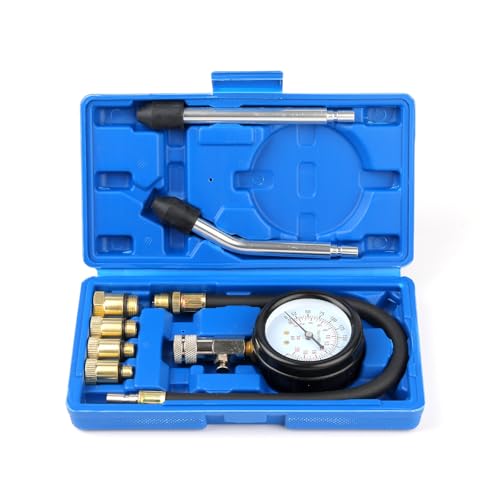
Reliable quality: Compression tester kit made of high-quality materials, and treated with rust and corrosion protection, sturty and durable enough. Large acrylic dial with rubber cover is convenient to read datas more accurately. Easy to Carry: Compression tester kit the handheld carrying case is ma More ...

MOTOPOWER MP00205A 12V 800mA Automatic Battery Charger, Maintainer, Trickle and Desulfator
Charger, Maintainer & Desulfator - An all-weather battery charger, battery maintainer, trickle charger, and battery desulfator. Perfect for charging and maintaining all 12-volt lead-acid, flooded or sealed maintenance free batteries (AGM and gel cell). Automatic Desulfation & Optimization - Automati More ...

High-Performance Car Jump StarterDriven by stable 4000A, the jump box for car battery portable can easily restart 12V dead vehicles up to 8.0L gas & 6.5L diesel engines in seconds even at -4140. Support more than 1000 jumps and easier than asking help from others or roadside service. 16800mAh Power More ...

SPECIFICATIONS: Weight capacity: 1800 lbs. This motorcycle wheel chock comes in a variety of adjustable sizes for a wide variety of applications. Compatible Hub Diameter17.7inch - 25.6nch. Compatible Tire WidthLess than 6 inches. Ensuring safe and secure storage. ADJUSTABLE LENGTH & WHEEL LOCK: Ther More ...

Our heavy duty Soft Loops Tie Down Straps are very durable for long-lasting performance, and have an impressive 1,800 lb capacity with 4,800 lb break strength!. These quality loops help to preserve the condition of your vehicles & equipment by keeping them secure, in place & prevents the scratching More ...

ROWYEET Motorcycle Cover Waterproof Outdoor Storage All Season Protection
Durable & Sturdy -- The Rowyeet motorcycle cover is crafted from 210D Oxford fabric with a three-layer structure, making it waterproof and tear-resistant. Universal Fit -- This size is 96.5'' L x 41'' W x 50'' H, designed to be compatible with most motorcycles/moped/vespa/dirt bike/E-bike, including More ...

8-in-1 Torque Wrench Set Includes 1/4, 3/8, 1/2 inch drive torque wrenches that meet your different needs. 5Pcs Adapter: 1/4"Extension bar(4''), 3/8"Extension bar(6''), 1/2"Extension bar(5''), 3/8" Universal Joint, 1/2" to 3/8" Adapter with a sturdy plastic case for storage and portability. Dual ran More ...

LLNDEI 48 Piece 1/4" Mini Socket Ratchet Wrench Set, Metric Shallow(4-14mm)
COMPLETE SET INCLUDES:1/4" drive shallow(Metric)socket:4mm,4.5mm,5mm,6mm,7mm,8mm,9mm,10mm,11mm,12mm,13mm,14mm;30pcs 1/4"drive bits;1pcs 1/4" bit coupler;1pcs 1/4"Dr. 72-teeth ratchet handle;1pcs 1/4"Dr.drill adapter;1/4" spinner handle;1pcs 1/4" universal joint;1pcs 3'' Extension bars;1pc storage ca More ...
Did We Miss Sump'm?
Sixty percent of the time, we're right every time. What would you add to the conversation and why? Your input is invited. Leave a comment and/or write an article!
Share Link ...


Thoughts gone wild? Write an article!